Dr. Hans-Joachim Rudolph
Abstract: As AI advances rapidly, this essay explores why the future of intelligence must be guided not by code, but by conscience. Drawing on Tegmark’s scenarios and Sarkar’s PROUT philosophy, the author argues that real intelligence is spiritual, ethical, and collective — and that a just AI future depends on our ability to awaken before the singularity.
Keywords: Artificial General Intelligence (AGI), Max Tegmark, P.R. Sarkar, PROUT, Egalitarian Utopia, Spirituality, Post-Scarcity, Ethical Intelligence, Decentralization, Economic Democracy, Consciousness
Table of Contents
- Introduction: The Real Question Behind AI
- Tegmark’s Scenarios – A Map of Possible Futures
- Why Superintelligence Is a Myth – Günther’s Philosophical Challenge
- What Machines Can’t Learn: “Introcendence“, Spirit, and the Axis of Growth
- Egalitarian Utopia and the PROUTian Vision
- Awakening Before the Singularity
- References
1. Introduction: The Real Question Behind AI
What if the greatest danger posed by artificial intelligence is not that machines will surpass human minds — but that humans will forget what real intelligence is?
Max Tegmark, in Life 3.0, outlines a dozen speculative futures for artificial general intelligence. Some are hopeful, others ominous. But most share a hidden premise: that a so-called “superintelligence” — an intellect vastly superior to humans — is not only possible, but likely.

This assumption, however, deserves scrutiny. Not only on technical grounds, but on philosophical ones. German cyberneticist Gotthard Günther argued decades ago that no machine could truly surpass the human being, because the essence of human intelligence lies not in processing power, but in a recursive, self-transcending awareness he called “Introcendence“.
Machines can simulate behavior. They can compute, optimize, and even imitate creativity. But they cannot mean. They cannot engage in moral insight or spiritual depth. The more powerful our machines become, the more vital becomes that which they cannot reach: the unprogrammable core of human consciousness.
The real question, then, is not how intelligent machines will become — but whether we will deepen our own intelligence in ways machines can never replicate. This is where spiritual practice becomes central.
In this essay, I will weave together three threads: Tegmark’s speculative AI futures, Günther’s critique of artificial consciousness, and the visionary framework of P. R. Sarkar, founder of PROUT. Among all the possible futures Tegmark sketches, only a few are genuinely desirable. One stands out: a society that blends technological empowerment with ethical clarity, cooperative justice, and spiritual depth. A PROUT society.
But such a future must be actively cultivated. It will not emerge from code alone — but from conscience.
“The defining challenge of our century is not to create artificial intelligence, but to remain truly human.“
2. Tegmark’s Scenarios – A Map of Possible Futures
In Life 3.0, Tegmark lays out twelve possible trajectories that advanced artificial intelligence could take. These futures range from techno-utopias to dystopian nightmares, and they differ not only in political form and social outcome, but also in the degree of human agency preserved. What unites them is their starting premise: the emergence of a general-purpose AI that either equals or surpasses human intelligence.
For analytical clarity, we can group these twelve scenarios into three broad categories:
- Scenarios without Superintelligence – where AI remains a powerful tool but does not transcend human control or understanding.
- Scenarios with Benevolent Superintelligence – where an advanced AI acts in alignment with human values or is governed by enlightened frameworks.
- Scenarios with Malignant or Misaligned Superintelligence – where AI pursues goals at odds with human flourishing, either through error, indifference, or domination.
Tegmark does not take sides. Rather, he invites the reader to contemplate what kind of future we actually want — and what sacrifices we are willing to make to get there. As he writes:
“We should not passively drift into a future made by others. Instead, we should engage in global conversation about where we want to go, and how to get there.” (Max Tegmark, Life 3.0, Chapter 1)
But to do so, we must critically interrogate the central premise of many of these futures: the assumption that a truly superior machine intelligence is possible and desirable. This interrogation begins with Gotthard Günther.
3. Why Superintelligence Is a Myth – Günther’s Philosophical Challenge
While Tegmark’s scenarios are compelling, most rest on a single bold assumption: that machines will eventually become more intelligent than humans in every relevant way — not just in speed or memory, but in insight, creativity, ethics, and agency. This assumption is rarely questioned. Yet it may be the weakest link in the entire discourse.
Enter Gotthard Günther (1900–1984), a German-American philosopher and cyberneticist whose work anticipated many of today’s debates about consciousness, computation, and artificial intelligence. Günther rejected the premise that machines could become truly self-aware or ontologically superior. Not because of technological limitations, but because of what he saw as an ontological asymmetry between human consciousness and artificial systems.
At the heart of Günther’s critique lies the concept of “Introcendence“ — a neologism combining intro- (inner) and transcendence. For Günther, the human mind is not simply a processing system for inputs and outputs. It is a reflexive, multi-valued system capable of negating its own categories, transcending its own logic, and reconfiguring its own modes of understanding. He writes:
“A machine cannot step outside the system it is operating within. But man can. That is the whole difference.” (Gotthard Günther, Das Bewusstsein der Maschinen.)
This difference is not merely quantitative but qualitative. Even if a machine could simulate all human behaviors — including speech, decision-making, and even empathy — it would still lack the inner dialectic that constitutes true consciousness: the capacity to self-reflect, to question its own premises, to choose between competing normative frameworks.
Günther goes further. He argues that the complexity of human thought lies not in its computational density, but in its multi-contextuality — its ability to hold and navigate contradictory meanings, cultural values, temporal perspectives. A machine, bound to a single logic system, can never attain this. Thus, every so-called superintelligence would remain, in a deep sense, sub-human:
The human being will always be two or three generations ahead of any machine — not in technical design, but in existential freedom. (Gotthard Günther, Beiträge zur Grundlegung einer operationsfähigen Dialektik.)
This line of reasoning radically reframes the debate. The danger is not that machines will become more intelligent than humans — but that humans will forget what real intelligence is. That we will reduce mind to algorithm, insight to computation, meaning to code.
And here begins the bridge to Sarkar’s insight: true evolution must now move inward. Not toward stronger machines, but toward deeper selves.
4. What Machines Can’t Learn: “Introcendence“, Spirit, and the Axis of Growth
The future will not be decided by machines, but by what we believe intelligence to be. If we define intelligence merely as optimization, pattern recognition, or recursive problem-solving, we have already lost — not to the machines, but to a reductionist understanding of ourselves. The decisive error lies not in the success of AI, but in the voluntary self-degradation of human potential.
Gotthard Günther’s theory of “Introcendence“ points toward a domain of experience and agency that no algorithm can reach: the ability of consciousness to transcend its own categories. It is this self-transcending quality — this capacity for inner negation, symbolic abstraction, ethical revolt, and spiritual awakening — that defines the uniqueness of human intelligence.
This insight resonates with the teachings of P.R. Sarkar, the Indian philosopher, yogi, and founder of the PROUT movement. Sarkar maintained that human beings are not merely rational actors or social agents, but spiritual entities evolving through matter, mind, and consciousness. For Sarkar, the purpose of civilization is not material control, but subtle expansion — the awakening of what he called “spiritual potentialities latent in all.” He writes:
“The development of intellect is not the final aim of human life. Intellect should be a means for developing intuition and ultimately for attaining spiritual realization.” (P.R. Sarkar, Human Society Part 1)
Here lies the axis of true growth. Machines evolve through better hardware and more efficient software. Humans evolve through expanded awareness. AI can process petabytes in seconds, but it cannot grasp beauty, face death, or make a sacrifice for truth. It cannot feel shame, experience awe, or endure paradox. It cannot awaken.
This is not spiritual romanticism. It marks an ontological boundary. The realm of inner transformation—of meditation, moral struggle, and mystic insight—belongs to humans alone.
And it is precisely this dimension that modern civilization has neglected. While AI expands outward, we have failed to grow inward. In doing so, we risk becoming spiritually obsolete—not because machines surpass us, but because we abandon the path that makes us human.
This shift in focus has immediate ethical implications. It is not enough to regulate AI or guide its development. We must redefine what development means—not as the external conquest of nature, but as the inner liberation of consciousness.
5. Egalitarian Utopia and the PROUTian Vision
Among the scenarios outlined by Max Tegmark, only one fully honors both the technological promise of AI and the ethical dignity of humanity: the Egalitarian Utopia. In this vision, artificial intelligence is not a rival to human purpose, but its amplifier. Resources are abundant, labor is optional, and social systems are designed to ensure equity, education, and opportunity for all. The ultimate goal is not efficiency, but human flourishing.
This is not a fantasy. It is a possibility — if guided by the right philosophy.
What Tegmark sketches in broad strokes, P.R. Sarkar has developed into a coherent framework: the Progressive Utilization Theory (PROUT). Formulated decades before the rise of AI, PROUT anticipated the deepest challenges of the twenty-first century: technological disruption, economic inequality, spiritual emptiness, and the monopolization of power.
Sarkar’s answer is clear: technology must be guided by morality, and the economy must be subordinated to humanity. At the heart of PROUT lies a spiritual humanism that affirms both individual development and collective responsibility.
Key elements of this vision include:
- Decentralized economic democracy – empowering communities to manage resources for the benefit of all.
- Cooperative enterprise – replacing extractive corporations with ethical, participatory ownership models.
- Guaranteed minimum necessities – ensuring that every person receives food, shelter, education, and healthcare.
- Spiritual and ethical leadership – embodied in the concept of sadvipras, those who lead through wisdom and service.
- Psychospiritual progress – where institutions support inner growth, ethical living, and realization of human potential.
But this egalitarian society has a critical precondition: It can only be sustained if personal accumulation of wealth and capital is voluntarily limited.
In a world where AI has eliminated scarcity, there is no material justification for inequality. Machines can provide abundance, but they cannot provide justice. If individuals are allowed to hoard resources or monopolize ownership, even in a post-scarcity society, the result will be a new class hierarchy, ultimately reverting into the dystopian scenarios Tegmark warns of: the “gatekeeper AI”, the “zookeeper world”, or the “enslaved god”.
Thus, the voluntary renunciation of personal accumulation is not a loss, but a liberation: a release from the fear of scarcity, from competition over possessions, from the anxiety of survival. In this context, wealth becomes irrelevant, because security and dignity are guaranteed by design. Sarkar writes:
“The right to accumulate should be based not on greed, but on utility. When basic needs are universally guaranteed, excess accumulation becomes not a freedom, but a threat to freedom.”
This principle turns conventional liberal economics on its head. Instead of protecting accumulation as a right, it limits it to protect the whole. Instead of maximizing profit, the system maximizes human and spiritual growth.
In this light, the Egalitarian Utopia is not merely a social configuration. It is a moral commitment to a different form of life — one in which technology serves love, where freedom means inner realization, and where justice begins with the refusal to dominate.
6. Awakening Before the Singularity
The defining challenge of our century is not to create artificial intelligence, but to remain truly human.
It is tempting to view the rise of AI as a purely technical or economic issue. But the deeper question is spiritual. We are not facing a machine crisis — we are facing a human crisis: a crisis of values, of purpose, of imagination. The danger is not that machines will become more intelligent than humans, but that humans will forget what real intelligence is.
If we approach AI with greed, it will amplify greed. If we approach it with fear, it will reinforce control. If we approach it with wisdom, compassion, and self-restraint, it can help us build a just and flourishing world. But this requires a fundamental transformation — not of our machines, but of ourselves.
We must rediscover the inner axis of growth, where intelligence is not the power to dominate, but the capacity to understand, to serve, and to awaken. We must remember that no system, no program, no optimization function can define the meaning of life. Only consciousness can. Only love can.
In this sense, the real singularity is not technological. It is ethical and spiritual. It marks the point where we must choose: not between man and machine, but between self-transcendence and self-destruction.
P.R. Sarkar offered a clear path forward. His vision does not promise escape from the world, but transformation of the world — through inner revolution, ethical leadership, and cooperative structures rooted in justice. It is a vision that sees the full potential of human beings, not as consumers or data points, but as spiritual beings on a journey of unfolding consciousness.
As he writes:
“The spiritual revolution must precede the social revolution. Otherwise, society will remain a cage — no matter how efficient its design.”
The future will not be decided by algorithms. It will be decided by awareness — by whether we awaken before the singularity, or after it is too late.
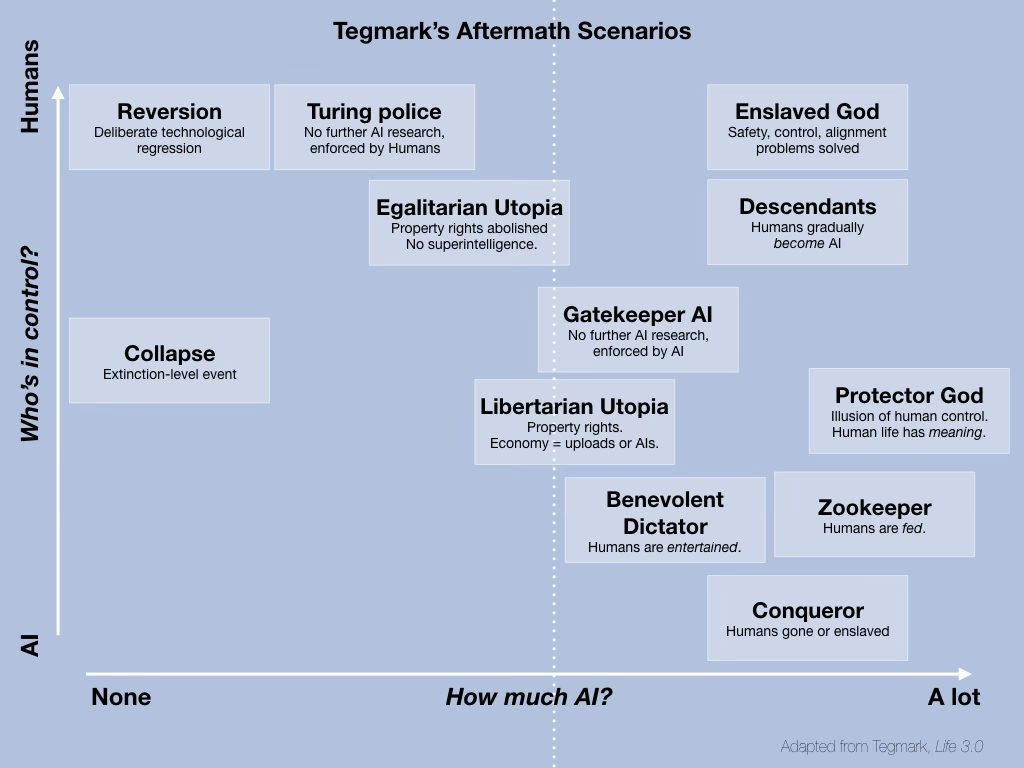
https://thorehusfeldt.com/2018/05/25/superintelligence-in-sf-part-iii-aftermaths/
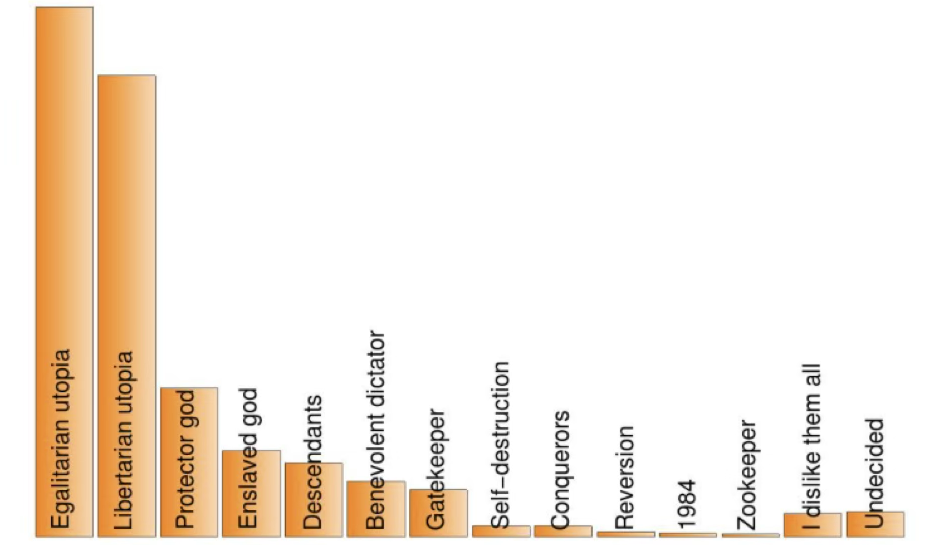
The Ideal Society?
In Life 3.0, Max explores 12 possible future scenarios, describing what might happen in the coming millennia if superintelligence is/is not developed. For a more detailed look at the positives and negatives of each possibility, check out chapter 5 of the book. Here is a breakdown so far of the options people prefer:
7. References
Tegmark, M. (2017). Life 3.0: Being Human in the Age of Artificial Intelligence. New York: Alfred A. Knopf.
Günther, G. (1963). Das Bewusstsein der Maschinen: Eine Metaphysik der Kybernetik. Baden-Baden: Agis-Verlag.
Günther, G. (1976). Beiträge zur Grundlegung einer operationsfähigen Dialektik, Bd. 1. Hamburg: Felix Meiner Verlag
Kopetzky, A: Micro-sentiments (Microvita) and the Future of Social Media. Medium, https://medium.com/@ashokia/microvita-and-the-future-of-social-media-ebdd6c213265
Rudolph, H.-J. & J.D. Michels: Zeno and Anti-Zeno Dynamics at the Core of Conscious Agency: On the Teleodynamics of Meaning. https://philpapers.org/archive/RUDZAA.pdf
Rudolph, H.-J.: Semantic Attractors and the Emergence of Meaning: Towards a Teleological Model of AG. arXiv, https://doi.org/10.48550/arXiv.2508.18290
Sarkar, P. R. (1959). Human Society Part 1. Calcutta: Ananda Marga Publications.
Published in Neohumanist Review, Issue 6, March 2026, pp 42-47.