Sohail Inayatullah is the UNESCO
chair in Futures Studies, Malaysia and
Professor, Tamkang University, Taipei
Sohail Inayatullah
Abstract: This essay explores the transformative potential of macrohistory by engaging three Asia based civilizational thinkers—Sima Qian, Ibn Khaldun, and P.R. Sarkar—in a comparative dialogue on historical cycles and the role of leadership in creating significant change. Drawing from Chinese, Islamic, and Indic traditions, it examines how virtue (te), social cohesion (asabiyya), and psycho-spiritual evolution serve as drivers of civilizational rise and decline. The essay situates these frameworks within contemporary global crises—planetary ecological collapse, inequity, loss of meaning, and the failure of global governance—and proposes four alternative futures: No Change, Marginal Change, Adaptive Change, and Radical Change. Each scenario is analyzed through governance, energy, macrohistorical lens, and core metaphor, offering insights into possible trajectories. Ultimately, the essay argues that while structural forces shape history, agency—embodied in the sage, the cohesive collective, and the sadvipra—can redirect the future toward planetary consciousness, cooperative economics, and spiritual renewal. Macrohistory thus becomes not only a tool for diagnosis but an asset for transformation.
The essay is based on presentations at the 2025 Gurukul Conference in Sinaia, Romania and the 2025 Proutist Universal Conference, Vig, Denmark. Assistance to this article was used via. 1. Digital twin of Sohail Inayatullah. 2. Gemini. 3. ChatGPT
The Grand Sweep of Time
Macrohistory is the endeavor to find patterns in meaning in the grand sweep of time. Macrohistorians look to the past not merely for a record of events, the litany, but for the patterns, the rhythms, and the narratives that guide the future. Macrohistorians, then, are more than time chroniclers; they are pattern-finders, theorists of civilizational rise and fall, and often, moral philosophers (Galtung & Inayatullah, 1997), asking not just the causes of change, but the factors to realize a better future. In this essay, we bring three such macrohistorians into dialogue: the ancient Chinese grand historian Sima Qian, the Islamic thinker Ibn Khaldun, and the 20th-century world philosopher P.R. Sarkar. We use their work not just to understand the present but map alternative futures. We conclude that we need their perspectives to manage the multiple crisis the planet is facing, what has been called the time of demons and monsters (Gramsci, 1971; Sarkar, 1991).
Though separated by centuries and distinct civilizational streams, these thinkers all sought to understand the deep structures of history. They saw history as more than a chaotic sequence of events, believing instead that it was shaped by discernible forces and moral or social imperatives. Sima Qian was preoccupied with the cycle of dynasties and the nature of virtuous leadership. Ibn Khaldun focused on the power of social cohesion as the engine of state formation and decay. P.R. Sarkar proposed a universal theory of social evolution driven by collective psychology and the quest for spiritual liberation (Inayatullah, 2002). By comparing their frameworks, we can explore fundamental questions that every society must face: What is the engine of historical change? Who are the agents of transformation? How can we use the past to create alternative futures?
We choose these three grand thinkers deliberately, that, while the work stretches over two thousand years, they all present cyclical theories of change and argue seek to transform the future through virtuous leadership. Sarkar, is, of course, recent and goes further, asserting for changes in the design of economic and governance systems. As well all three are non-western in origin: Sinic, Islamic, and Indic. We eschew for the purposes of this essay, western macrohistorians such as Toynbee, Sorokin, Comte, Spencer, Marx, and Gramsci (Galtung and Inayatullah 1997). Finally, the purpose of this essay as well is not just comparative macrohistory but to glean insights from these thinkers to understand possible futures.
The Tao and the Mandate of Heaven: Sima Qian’s Vision of Order
To understand Sima Qian, one must first grasp the philosophical currents of ancient China, particularly the concept of the Tao. As articulated by the philosopher Chang-Huseh Chang (Watson, 1958), the Tao is not a deity that intervenes in human affairs, but the inherent potential within human nature for an ordered, civilized existence (Xie and Inayatullah, 1997). It is the formless principle that “began ‘taking form’ in human history with the first human family and continued as population increased and human society became more and more complex.” The Tao is the why behind events, an evolutionary process embedded in the moral order that must be intuitively and holistically understood.
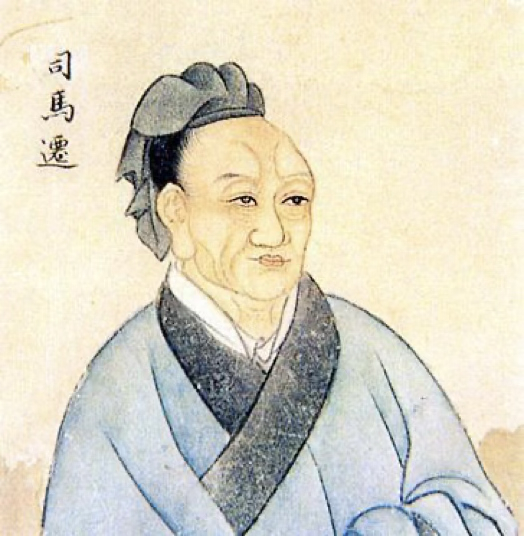
Chinese historian Sima Qian c. 145 BC – c. 86 BC.
Image from the Creative Commons.
The common person, in this view, participates in this process blindly, driven by immediate necessity. The sage, however, is different. By observing the ebb and flow of life—the yin and yang of events—the sage perceives the workings of the Tao and can create appropriate institutions and laws. The sage is a free agent who “takes the part of the Tao,” not its unwitting pawn. This is a crucial distinction from a Hegelian worldview, where the “cunning of Reason” uses great men to advance history behind their backs (Galtung and Inayatullah, 1997). For the Sima Qian, the sage is a conscious collaborator with the deep patterns of the universe. This differs from the Vedic concept of incarnation; the Tao does not incarnate in a sage, whose actions are limited by historical conditions. The Classics, then, are not books that expound the Tao, but the material embodiment (chi) that exhibits it, inseparable from the material world “than a shadow can be separated from the shape that casts it” (Xie and Inayatullah, 1997).
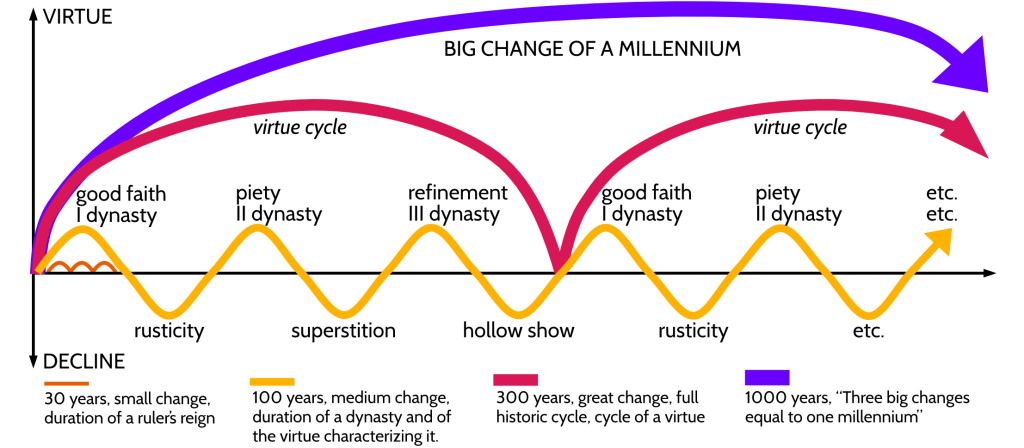
Image by Daniela Minerbi in Galtung and Inayatullah, 1997, p. 249.
Sima Qian built his historical framework, the Shih Chi, upon this foundation. His aim was explicitly: to “examine the deeds and events of the past and investigate the principles behind their success and failure, their rise and decay” (Watson, 1958). The purpose was fundamentally moral—to censure evil and encourage good, preserving the record of virtue for posterity. This project was framed by a conception of time different from the West. Ancient Chinese and Indict thought saw time as astronomical and cyclical, a series of vast cycles based on the movements of the planets (Eliade, 1954). In contrast to Western or Islamic history, which begins from a dramatic, datable event like the birth of Christ or the Hegira, history based on the stars has no absolute beginning or end.
Within this cyclical view, Sima Qian identified the pattern of dynasties. Each dynasty begins with a sage-king of superlative wisdom, such as Yu of the Hsia, and ends with an evil and degenerate monarch, like Chou of the Yin (Watson, 1958). The engine of this cycle is te. As Watson (1958) writes, te is more than virtue; it is “a kind of mystical store of power set up by the sage ancestor of the family… But like all other things of creation, this ancient deposit of merit is subject to the law of decay” (p. 7). As generations pass, the power thins. A worthy ruler can still emerge to perform an act of “revival or restoration,” but if no leader replenishes the store of merit, the dynasty collapses and a new family with the “Mandate of Heaven” rises. Sima Qian added another layer to this theory of decay: the principle of alteration, where a dynasty’s dominant characteristic becomes its opposite. The good faith of the Hsia became rustic; the piety of the Shang turned into superstition.
Crucially, however, Sima Qian was not a simple restorationist. He believed that “history… was a constant process of growth and it was impossible to think of returning to some static golden age of the past. What was possible, however, was the creation of a new golden age in the present by a wise application of moral values appropriate to the times” (Watson, 1958). The implications for the future are considerable but most significantly it is not technology – neither AI nor a race to Mars – that can solve today’s problems of inequity, genocide, patriarchy, and extinction from climate change, but virtuous leadership. The means do not justify the end. Where there is virtue civilization progresses, where virtue becomes “fake news” nations and civilization declines (ET Bureau, 2020), the tao disappears and nations war.
Asabiyya and the Desert’s Edge: Ibn Khaldun’s Sociological Cycle
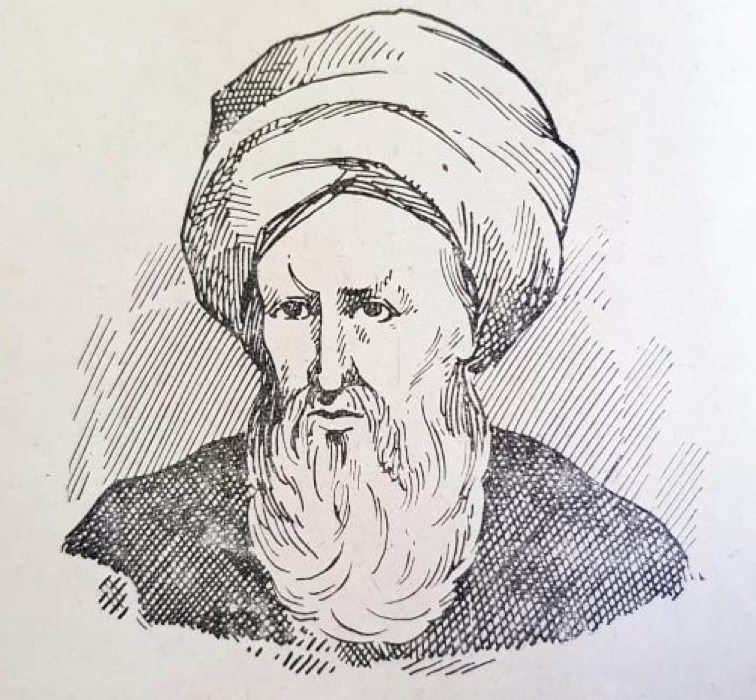
Ibn Khaldun.
Image from the Creative Commons.
Ibn Khaldun, writing in the 14th century, considered to be the founder of Sociology, offered a strikingly different, materialist explanation for the rise and fall of dynasties. For him, the key variable was not mystical virtue but a tangible social force: asabiyya. As he outlines in The Muqaddimah, asabiyya can be understood as group solidarity or social cohesion (Khaldun, 1967). This force is strongest among groups living in harsh conditions, such as desert Bedouins.
This potent asabiyya gives a group the power to conquer more sedentary, civilized populations whose own social cohesion has weakened. The victorious group establishes a new dynasty, but this very success becomes the seed of its downfall. Over several generations, urban life erodes the harsh conditions that created asabiyya. The ruling class becomes soft and individualistic, their group solidarity dissolves, and they become vulnerable to a new group from the periphery with a fresh and powerful asabiyya (Khaldun, 1967). Each generation weakens, moving from innovation to imitation, and over four generations the dynasty is prey to the outside Bedouins, who have unified through adversity. Group feeling also decreases with imperial expansion. More funds must be paid out. to the soldiers and to the masses. With increased luxury, group feeling decreases. Thus, to deal with crises, rulers pay out more money, which hastens the decline. This is in sharp contrast to the beginning of the dynasty, when it had a desert attitude – with no extravagant expenditures, a sense of royal authority and with regular fasting and other spiritual practices by the leaders (Inayatullah, 1999, 60).
Of course, during the end of the dynasty (empire), there often appears to be rejuvenation, a new leader, for example, who attempts to bring back the past. Writes Khaldun:
“Group feeling has often disappeared (when the dynasty has grown senile) and pomp has taken the place it occupied in the souls of men. Now, when, in addition to the weakening of group feeling, pomp, too, is discontinued, the subjects grow audacious vis-à-vis the dynasty. At the end of a dynasty, there often also appears some (show of) power that gives the impression that the senility of the dynasty has been made to disappear. It lights up brilliantly just before it is extinguished, like a burning wick, the flame of which leaps up brilliantly a moment before it goes out, giving the impression it is just starting to burn, when in fact it is going out” (Khaldun 1967, 246).
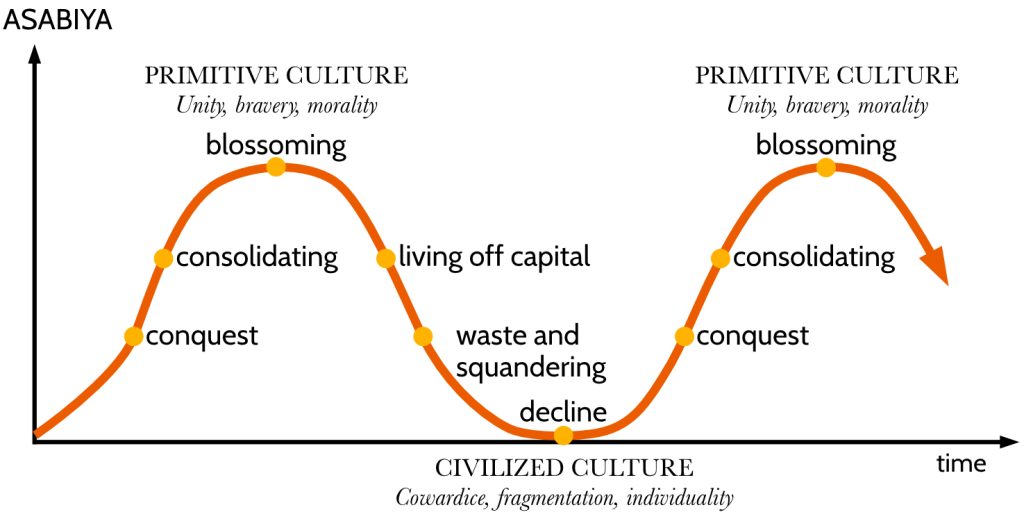
Khaldun’s civilizational cycle. Reproduction of image by Daniela Minerbi in Galtung and Inayatullah, 1997, p. 250.
The Social Cycle and the Spiral: P.R. Sarkar’s Theory of Transformation
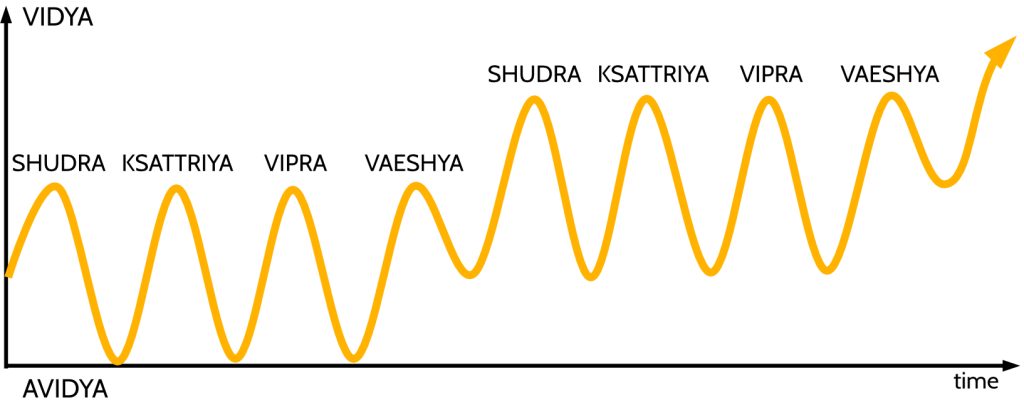
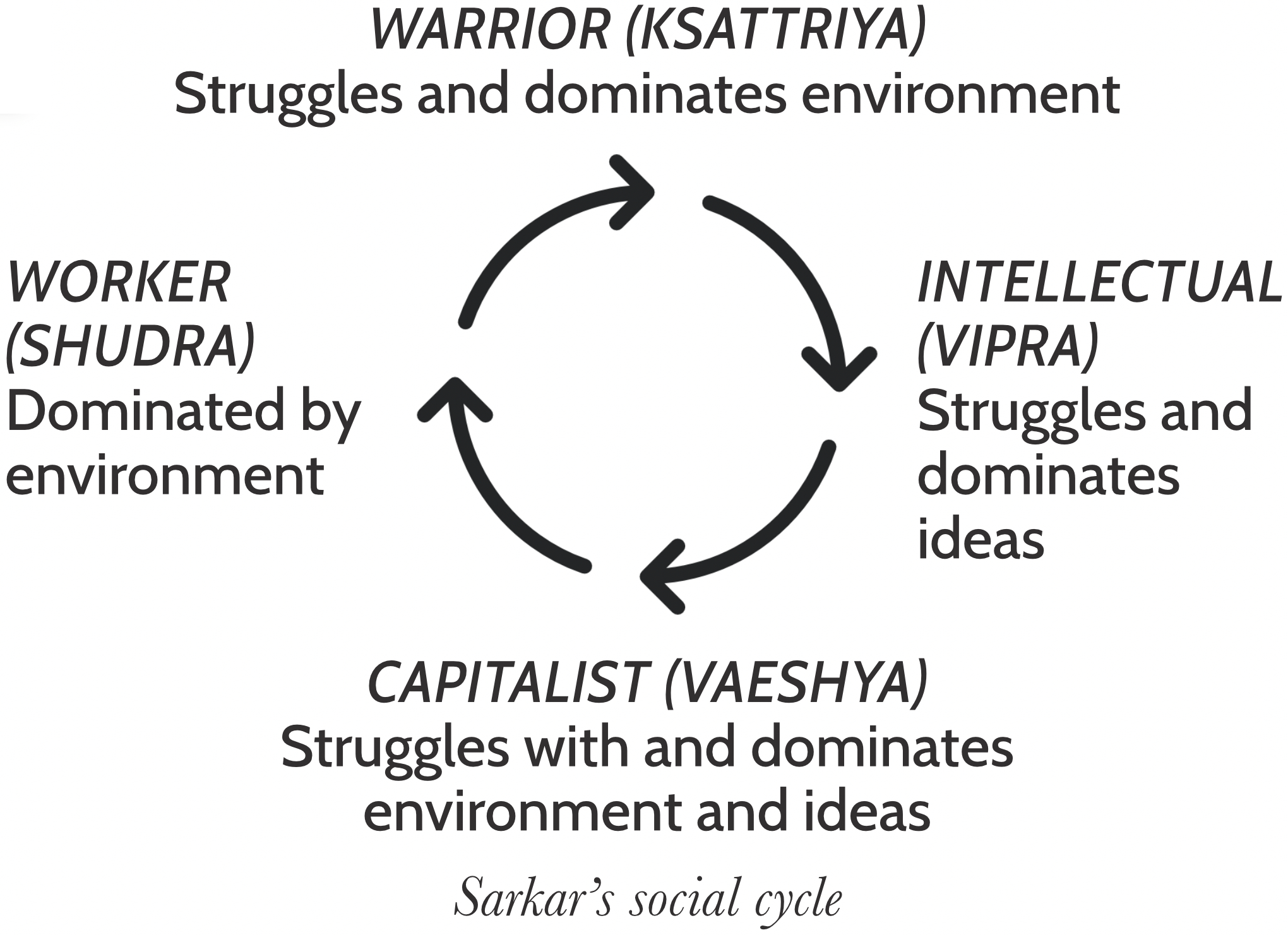
Shrii Prabhat Ranjan Sarkar offers a third model, rooted in collective psychology. His theory of the Social Cycle posits that every society moves through four eras, each dominated by a class with a specific mental makeup, episteme, or varna: the laborer (Shudra), the warrior (Kshatriya), the intellectual (Vipra), and the capitalist (Vaeshya) (Sarkar, 1967; Inayatullah, 2002). Each class rises to power, dominates, and then enters a phase of exploitation, creating the conditions for the next class to lead a revolution or evolution, or in some cases a counter-revolution, returning for a short period to the previous era. For Sarkar, varna is deeper than class; however, in late capitalism, when exploitation as its extreme, the other groups become “shudraized,”- they lose agency and have their wills bent by the power of interests and goals of capitalists for the endless accumulation of wealth, of “more.”
For Sarkar, this cycle, however, can be transformed; progress is possible as the true driving force is the evolution of consciousness, a struggle between the materialist force of exploitation (Avidya) and the spiritual force of liberation (Vidya). This is framed in Tantric philosophy where the Divine exists both within the world (Saguna Brahma) and beyond it as formless potential (Nirguna Brahma). The agent of true progress in this model is the Sadvipra spiritually realized and courageously active individual who fights exploitation at each age. Their role is to ensure the cycle “spirals” upward, creating a society with greater well-being and deeper spiritual awareness (Inayatullah, 1999, 2002, 2017). Sarkar’s project is not to preserve an old order but to provide a roadmap for conscious evolution that challenges the cycle yet embraces the structure of different archetypes of power (the worker, the warrior, the intellectual, the accumulator of capital). The sadvipra is created through the dialectics of the social cycle where individuals find themselves unable to express their needs. They just challenge the current system and ensure progress. In today’s era, this means, challenging the dominance of patriarchy, the nation-centric system (geo-politics), of economism and ensuring an alternative cooperative economics and culture where nature, technology, consciousness and human co-evolve.
A Dialogue Across the Ages
Placing these three frameworks side-by-side reveals a fascinating dialogue. All three thinkers see history as cyclical, a departure from linear models (Galtung & Inayatullah, 1997). Yet their engines of change are distinct: for Sima Qian, it is the accumulation and decay of te (virtue-power), which is granted to those who follow the cosmic principle of the Tao; for Ibn Khaldun, it is the sociological force of asabiyya; and for Sarkar, it is the psycho-spiritual evolution of the collective mind.
Their agents of change are equally diverse. For Sima Qian, it is the sage-king, an insider who creates a new golden age. For Khaldun, it is the cohesive collective from the periphery, the Bedouins. For Sarkar, it is the Sadvipra, the spiritual revolutionary who is often an outsider, who can integrate the vidya aspects of the four varnas ie can serve, can protect, can innovate, and can ensure money keeps on moving. This gives us three distinct pathways to power: through virtue, through solidarity, and through transformed consciousness.
Using Macrohistory to Shape the Future
What, then, can this ancient dialogue offer us today? We are witnessing the decay of old systems, the rise of new technologies, and a palpable sense of being at the end of one era and on the cusp of another. Virtue as our macrohistorians understood it is now challenged at its core. Misinformation, mal-information, dis-information not to mention the politics of obfuscation through the fake news and alternative facts narrative do not create a more pluralistic world, but rather a world where the Tao has disintegrated, and virtue is in accelerated decline. The basis for society is even questioned as nihilism dominates.
Sima Qian ’s framework reminds us of the importance of virtue in leadership. Ibn Khaldun’s analysis provides a sobering, sociological perspective, reminding us of that social cohesion—asabiyya—is the bedrock of political power. However, while they focused on dynasties, Sarkar moves the unit of analysis not to civilizations (as Toynbee, Spengler, and to some extent Sorokin argued) but to humanity and Gaia as a whole. Sarkar’s framework gives us a dynamic and empowering lens, suggesting our current challenges are characteristic of a late-stage capitalist era and that transformation is possible through conscious individual and collective action (Inayatullah, 2002). This means, bringing the Tao and asabiyya back by:
- Shifting from patriarchy to coordinated cooperation
- Shifting from the nation-state to neohumanism or planetary consciousness
- Shifting from capitalism to economic democracy
- Shifting from national governance to global and a world government
- Shifting from luddite view of technology to embracing new technologies while ensuring that they amplify equity and deep spiritual culture
- Shifting from an image of the future where the individual, materialism, and man are the centre to an image of the future where all humans, spirituality, and women-men-nature are the centre
This shift thus creates a new asabiyya or unity. While in Khaldun’s time it was the Bedouins who stood at the city gates and challenges dynastic power, today, the alternative social movements and sadvipras challenge the status-quo.
Alternative futures
While the above asserts what is possible, emerging uncertainties and challenges suggest that this is far from likely. To map out the possibilities, we use the Change Progression Scenario method, a futures‑studies technique that maps a system’s step‑by‑step evolution and helps guide decisions toward incremental, measurable benefits (Milojevic, 2005).The challenges ahead include (Inayatullah, 2021):
- The ecological crisis, the endless need for products creating tipping points in the natural world such that regeneration of nature becomes more difficult. The result is the base of the system, nature, is no longer sustainable. There is no planet B.
- The crisis of inequity. Since the beginning of the neo-liberal revolution there has been a dramatic rise of inequity throughout the world. This does not mean the middle class has not prospered; however, it does mean that the gap between the wealthiest and the poor continues to rise between nations and within nations. And expectations in the global internet world have not been reduced; indeed, everyone now wishes to become a bitcoin billionaire.
- The crisis of meaning, the search for purpose, joy, and happiness in a world where the latter is defined primarily by the accumulation of material goods.
- The crisis of work in a world where artificial intelligence and advancement in new technologies is likely to end the job or at least dramatically negate the possibility of one stable job over one’s lifetime (Inayatullah, 2020).
- The crisis of governance. Governance is regulated within nations but generally poorly regulated outside of the nation state. It is a wild west, making global agreements around critical issues – pandemics, taxation, criminal activity, and climate change extremely difficult.
- The crisis of inclusion. Even as a few get more of the pie, the others: women, nature, the previous colonies, wish for entrance into the system. The current exclusionary system challenges the ability of the system to maintain its structure.
Essentially the trajectory of the last few hundred years is increasingly seen as unviable. These crises all suggest, as the world systems thinker Immanuel Wallerstein (2004) has argued, the challenges of the current system cannot be resolved within the terms of the system i.e., capitalism, the nation-state, and global cultural tribalism.
Given the preferred trajectory in the context of the crisis head, what are the alternative futures? We articulate four: No Change, Marginal Change, Adaptive Change, and Radical Change.
No Change: contradictions abound
This is the future of systemic collapse, the result of a failure to change. The organizing principle is the terminal decay of the old order.
Governance: The nation-state model proves utterly incapable of addressing planetary crises. Trapped in zero-sum thinking, national governments fail to cooperate, leading to paralysis and a collapse of trust in all institutions. The “shattered throne” is the throne of national sovereignty, now proven useless against the forces of a globalized world.
Energy: The world remains locked into a fossil fuel economy. The inability of nations to agree on a coordinated response means that tipping points are crossed, and runaway global warming becomes an irreversible reality, accelerating the collapse of food systems, supply chains, and social order.
Macrohistorical Lens: Sima Qian would see this as the inevitable end of a dynastic cycle where virtue (te) is exhausted. Ibn Khaldun would diagnose it as the terminal dissolution of asabiyya (social cohesion). For P.R. Sarkar, it is the chaotic nadir of the late capitalist era, where the “demons” of exploitation preside over a complete systemic breakdown.
Core Metaphor: The core metaphor for this scenario is the “shattered throne.” While we live today in a democratic era, recent events are conclusive: there is a return to authoritarianism, to the rule of the king. In this future, no change leads to a collective disaster, the tao disappears, and the contradictions between the finance economy and the real economy; between centre and periphery; between billionaire and the poor, between patriarchy and submission, lead to civilizational disintegration.
Sima Qian would recognize this as the dawn of a new golden age, where virtuous leadership and a spiritually resonant technology creates a civilization in harmony with the planetary Tao.
Marginal Change: Anxiety magnified
This future represents a defensive reaction to collapse, an attempt to restore order through marginal, security-focused adjustments. It is certainly a better future in terms of inclusion and prosperity, but the contradictions remain, just partially addressed.
Governance: Power coalesces into regional associations or blocs (a Fortress Europe, a Pan-Asian Sphere, a North American Union). These are not cooperative ventures but defensive alliances, each with a high degree of internal cohesion but deep mistrust of the others. The world becomes an archipelago of fortified islands.
Energy: The transition to renewable energy occurs, but in a fragmented way. Each regional bloc develops its own self-sufficient but unconnected grid to ensure energy independence from its rivals. Energy is weaponized, used as a tool of geopolitical strategy rather than a shared resource for humanity.
Macrohistorical Lens: This is Ibn Khaldun’s fractured asabiyya on a global scale. For Sarkar, it is a counter-revolution, a regression to a warrior mentality focused on security and control, lacking a unifying dharma. Sima Qian would see these regional leaders as lacking a universal Tao, ensuring a cycle of conflict continues.
The core metaphor is the Archipelago of Fear. While the positive are the creation of regional alliances and the move toward efficient, circular economies with AI leading to unprecedented efficiencies and productivity, there is a lag in providing retraining for blue- and white-collar workers – only gold collar workers, the designers survive without scars. The rest see some improvement but carry burden and dread, waiting for their jobs to disappear while knowing full well that there is no springboard, no universal health care, purchasing power, nor universal basic assets available.
Adaptive Change: The possibility of hope
This scenario depicts a sophisticated, top-down adaptation that manages global crises but without a fundamental shift in consciousness. While it adapts to the external contradictions it does not resolve the inner prama, the spiritual challenge.
Governance: A system of global governance of the regions emerges, functioning like a corporate board of directors for the planet. The powerful regional blocks from the previous stage cooperate to manage resources and maintain stability, the hints of deep democracy begin with a one person and one vote system. Regional associations create a global governance system.
Energy: The technological backbone of this world is a highly efficient, AI-managed, decentralized and integrated global grid. This smart grid eliminates the energy crises of the past and provides a high standard of living, but it also enables a new level of surveillance and control. Comfort and security are traded for agency.
Macrohistorical Lens: This is the future of an inclusive society. Sarkar’s sadvipras have risen and begin to serve and demonstrate deep spiritual activism. Sima Qian would view it as a world where the Tao has entered society. technical prowess and moral wisdom go hand in hand. Ibn Khaldun would see asabiyya on the rise, not from religion from the evidence based spiritual practice. The system, however, is brittle, vulnerable to unforeseen shocks.
The metaphor is shared hands. In this future, the numerous crisis and contradictions force the creation of deep cooperation, not the invisible hands of the market, nor the visible hands of the East Asian model. Instead of the single bottom line, a quadruple bottom line is created: prosperity, people, planet, and purpose (spirit). There is a shift from the corporatist model to the cooperativist model. This model uses new AI driven platforms to create robust peer to peer network. Efficiency is gained through the progressive use of physical and mental resources. Regional confederations being to accede sovereignty to a world government structure. From accumulation for the sake of accumulation, we shift to a world of meaning making. There is abundance at all levels. Wellbeing – of self, others, nature, and community – becomes far more important. Indeed, the shift from GDP to Wellbeing as the dominant metrics is successful. Identity shifts from nationalism, and “I shop therefore I am to I create and contribute”, therefore, I and we are. With purchasing capacity guaranteed because of Artificial intelligence led productivity and Universal basic income/asset schemes ensuring safety and security individuals can begin to move toward trust and identity abundance and thus the politics of land, nation, and religion erode. The social contract is expanded (Bjonnes and Hargreaves, 2016).
Radical Change: Living in the Age of Microvita
This future embodies deep, foundational change based on a radical transformation of consciousness, energy, and politics.
Governance: The tangible political expression of a new planetary consciousness is a true world government. This is not a centralized empire but a democratic, confederal structure that grows organically from the bottom up. It dissolves the old architecture of competing nation-states and manages the planet as a shared commons, acting as the visible expression of the invisible mycelial connection between all peoples. One person, one vote is possible but more likely is a tensegrity of structures (house of regions, house of individuals, and house of outlier nations)
Energy: The material foundation for this new world is energy abundance, likely achieved through a breakthrough like commercially viable fusion or another novel, clean source – a global green integrated and decentralized grid, for example. Or the creation of global renewable energies including direct beaming of sunlight through modified Dyson spheres (Hirsch, 2019). This effectively ends resource competition, among the main drivers of conflict in the old world and enables a post-scarcity economy focused on well-being and creativity. Finally, cellular agriculture fused with organics plays a pivotal role in ending hunger.
Macrohistorical Lens: This is the world of the New Asabiyya, rooted in what Sarkar called positive microvita—the subtle energies of cooperation and universal love. Sima Qian would recognize this as the dawn of a new golden age, where virtuous leadership and a spiritually resonant technology creates a civilization in harmony with the planetary Tao. Instead of a battle against a particular group, the focus is on creating a global vision of the future grounded in spiritual, social justice, and the use of resources for the greater good. It is not a world without contradictions, but these tensions are used for greater progress.
The new metaphor is the Mycelial Network. The Gaian system becomes alive. As argued elsewhere (Inayatullah, 2021), dramatic gains in artificial intelligence end the scarcity-based world economic system. Ownership disappears as trust remerges, creating a politics of abundance. Capitalism becomes a distant memory. Money as we know it today also disappears as needs can be directly met. Work is design-based and about resolving conflicts between individuals and collectivities. Notions of tribal identity disappear, indeed, with the invention of the artificial womb, procreation is forever delinked from the body. We are co-creators with technology and nature. Microvita plays a role in expanding production in novel ways (Sarkar, 1987). The sadvipra revolution Sarkar imagined decades ago is successful. The Tao return and asabiyya is regained.
| KEY VARIABLE | Adaptive Change Possibility of Hope | Marginal Change Anxiety Abounds | Adaptive Change Possibility of Hope | Radical Change Age of Microvita |
| Governance | Nation-state failure; sovereignty collapses. “Shattered throne” of legitimacy. | Defensive regional blocs: mistrust dominates. “Fortress alliances.” | Cooperative global governance emerges. Hints of deep democracy and shared stewardship. | Bottom-up world government. Confederal tensegrity structures. |
| Energy | Fossil fuel lock-in; tipping points crossed. Runaway collapse. | Fragmented renewables; energy weaponized. Strategic isolation. | AI-managed smart grid; abundance with surveillance. Comfort vs agency. | Fusion/Dyson breakthroughs; post-scarcity. Global green abundance. |
| Macrohistorical Lens | Sima Qian: virtue exhausted. Ibn Khaldun: asabiyya dissolved. Sarkar: capitalist nadir. | Khaldun: fractured global asabiyya. Sarkar: warrior regression. Sima Qian: Tao absent. | Sarkar’s sadvipras rise. Sima Qian: Tao enters society. Khaldun: spiritual asabiyya. | Sarkar: positive microvita. Sima Qian: golden age dawns. Khaldun: planetary cohesion. |
| Metaphor | Shattered Throne – collapse of legitimacy, return to authoritarianism, contradictions unbridgeable. | Archipelago of Fear – fortified regions, dread, gold-collar survival. | Shared Hands – quadruple bottom line, peer networks, wellbeing. | Mycelial Network – planetary consciousness, trust economy, co-creation. |
The Reality of Today: Living Amongst Demons
But while Sarkar’s sadvipras act to create different future, and in our fourth scenario, they are successful, the reality of today is decay – the pervasive lack of honesty and integrity in contemporary politics. Data is not used to create shared values but degraded and weaponized. From Sima Qian ’s perspective, this would be an unmistakable sign that the te of the current order is exhausted. Leaders who act with blatant self-interest have moved far from the Tao; they are the “evil and degenerate” monarchs who signal the end of a dynastic cycle (Watson, 1958). Ibn Khaldun would see this not just as moral failure but as a symptom of dissolved asabiyya; when leaders no longer feel a deep bond with the people, they rule for personal gain, signaling the dynasty’s final, vulnerable stage. Sarkar (1967; Inayatullah, 2002) would frame this same crisis as a systemic abandonment of yama and niyama, the foundational ethics that must underpin any healthy society. He would see this corruption as a predictable feature of the late Vaeshyan era. As Sarkar wrote: “This is the age of demons. The forces of darkness are in ascendance, and only the light of dharma can dispel them.” (Sarkar, 1991, p. 35). For all three, a crisis of integrity in leadership is a definitive symptom of a dying age, and the path forward requires a new vanguard—be it a sage-king, a group with renewed asabiyya, or the revolutionary sadvipras. It is as leaders from workshops in Thailand suggested, a need to move from drama as the organizing principle of society to dharma (Milojevic et al, 2026).
Ultimately, this comparison illuminates different uses of the future. One is to learn from the past, to understand that we are in a catastrophe decline. Another is to understand the sociological forces that bind, and break societies can also be used to change the past. The third is to consciously create a transformed future, to create eutopia. In our current “galloping time,” (1991, p. 35) we need to understand all three. We need the wisdom of Sima Qian to call for virtue, the realism of Khaldun to rebuild social cohesion, and the transformative vision of Sarkar to help us break free from the used futures of a dying era. The task for futurists, social change activists, and innovators is not merely to be scribes of a declining age, but to become the architects of the next. The scenarios presented both describe but also create spaces for individual and collective action. Thus, while macrohistory begins with structure, it concludes with agency, with possibility. Sarkar’s quote on the role of exceptions in human evolution says it best and is a fitting way to conclude his essay (Anandamurti, 1979):
“One of the most important factors on the path of movement is the exception. Those people who are society’s exceptions are extraordinary people. For those people treading a new path, who are constructing something new, exception is as valuable as their lives. You should also know that you are exceptions. You, too, will do something great, will build something historical.”
The challenge, as Gramsci (1971) wrote, is during the interregnum, when the old is dying and new cannot be born. However, while this may have been true in the 1930s when Gramsci wrote this sentence, now at the quarter mark of the 21st century, it no longer holds. The new can be born.
References
Anandamurti, S. S. [Prabhat Ranjan Sarkar]. (1979). Ánanda Vacanámrtam: Part 8. Ananda Marga Publications. Electronic Edition of the Works of P. R. Sarkar, Version 9.0. https://prsinstitute.org/electronic-edition/
Eliade, M. (1954). The myth of the eternal return: Cosmos and history (W. R. Trask, Trans.). Princeton University Press.
ET Bureau. (2020, October 2). Virtue economics is vital for capitalism: Jeffrey Sachs, American economist. The Economic Times. https://economictimes.indiatimes.com/news/international/world-news/virtue-economics-is-vital-for-capitalism-jeffrey-sachs-american-economist/articleshow/78451471.cms
Galtung, J., & Inayatullah, S. (Eds.). (1997). Macrohistory and macrohistorians: Perspectives on individual, social, and civilizational change. Praeger.
Gramsci, A. (1971). Selections from the prison notebooks of Antonio Gramsci (Q. Hoare & G. Nowell-Smith, Eds. & Trans.). London: Lawrence & Wishart. (Original work published 1977 in Quaderni del Carcere, Vol. 1, Quaderni 1–5, Turin: Giulio Einaudi Editore), 276.
Inayatullah, S. (1999). Situating Sarkar: Tantra, macrohistory, and alternative futures. Gurukul Press.
Inayatullah, S. (2020). Scenarios for teaching and training: From Being ‘Kodaked” to futures literacy and futures-proofing. CSPS Strategy and Policy Journal. (8):31-48.
Inayatullah, S. (2021, July 1). The invisible hand or inclusive flow: The futures of the world system. Journal of Futures Studies. https://jfsdigital.org/2021/07/01/the-invisible-hand-or-inclusive-flow-the-futures-of-the-world-system/
Inayatullah, S. (2002). Understanding Sarkar: The Indian episteme, macrohistory and transformative knowledge. Brill.
Inayatullah, S. (2017). Prout in Power. Proutist Bloc India Publications.
Khaldun, I. (1967). The Muqaddimah: An introduction to history (F. Rosenthal, Trans.). Princeton University Press. (Original work published 1377)
Milojevic, I. Inayatullah, S., Poocharoen, O., Boonmavichit, N. (2026, in press)). Drama to Dharma and the Holographic Buddha: Futures Thinking in Thailand. Journal of Futures Studies.
Milojević, I. (2005). Educational futures: Dominant and contesting visions. Routledge.
Sima Qian. (1993). Records of the grand historian of China (B. Watson, Trans.). Columbia
Sarkar, P. R. (1967). Human Society, Part 2. Ananda Marga Publications.
Sarkar, P.R. (1987). Microvitum in a Nutshell. Ananda Marga Publications.
Sarkar, P. R. (1991). Human Society, Part 1. Ananda Marga Publications.
Xie, C., & Inayatullah, S. (1997). Ssu-Ma Ch’ien: The cycles of virtue. In Galtung, J. & Inayatullah, S. (Eds.), Macrohistory and macrohistorians: Perspectives on individual, social, and civilizational change (pp. 12-17). Praeger.
Wallerstein, I. (2004). World systems analysis. Durham: Duke University Press.
Watson, B. (1958). Sima Qian: Grand historian of China. Columbia University Press.2020).
Published in Neohumanist Review, Issue 6, March 2026, pp 18-23...56-60.