
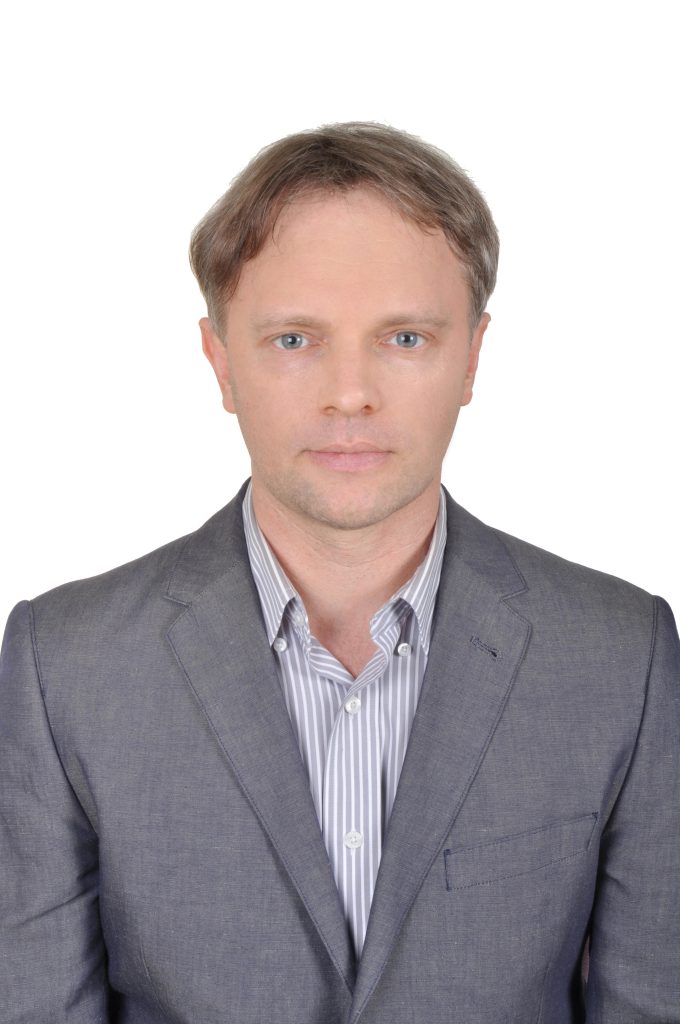
Dr. Justin M. Hewitson is an Associate Professor at the Institute of Philosophy of Mind and Cognition in National Yang Ming Chiao Tung University, Taiwan. He specializes in the comparative study of consciousness within India’s meditative traditions, including P.R. Sarkar’s Śiva Tantra, Shaivism, Yoga, Vedānta, and Buddhism. His research bridges the gap between Eastern ontological frameworks and Western traditions covering phenomenology, existentialism, idealism, and ethics.
Justin Hewitson
This essay was funded by The National Science and Technology Council of Taiwan. NSTC 113-2410-H-A49-044-
Abstract: This essay engages with the debate over the hard problem of consciousness formulated by David Chalmers: why does sentience arise in matter? It interrogates Western physicalism via idealist arguments to challenge the philosophical incoherence of strict empiricism. Establishing the framework of the physicalist-idealist debate exposes the explanatory limits of physicalism — particularly the inadequacies of quantum field theory and weak emergentism in accounting for consciousness. After examining Chalmers’s analyses of the dominant scientific and philosophical arguments, the essay proposes that Prabhāt Ranjan Sarkar’s modern Tantric idealism develops an ontological response that incorporates physicalist emergentism without succumbing to metaphysical incoherence. Sarkar’s Brahma Cakra (cycle of creation) provides a rational metaphysical framework that describes how the unqualified Cosmic Consciousness (Metaseity) and its three qualifying energies (guṇas) generate matter. In this cycle, nescience and entropy cause the progressive crudification/contraction of Metaseity’s unqualified consciousness into mind, then inanimate matter. The syntropic re-emergence of sentience in matter progresses through increasingly complex cellular structures. Sarkar’s idealism arguably dissolves the combination problem faced by Russellian monism and the circularity of weak emergentism by viewing consciousness as ontologically primary and matter as its constrained expression. Finally, while conceding the empirical challenge of verifying Sarkar’s ontology, the essay proposes that Tantra’s first-person meditative phenomenology is a neglected resource for transdisciplinary studies of metaphysics and mind.
Keywords: Tantra, the hard problem of consciousness, P.R. Sarkar, emergentism, physicalism, ontology, Brahma Cakra, sentience
Introduction: The Physicalist-Idealist Debate

In 1995, David Chalmers presented the now-entrenched hard problem of consciousness: why do qualia — and specifically the sentient ‘I’-experience — arise in matter? While physicalism dominates the scientific worldview, it has failed to coherently explain how the inert baryonic matter that constitutes biological life generates consciousness. As a form of material reductionism, physicalism has traditionally searched for a fundamental physical essence, but that substance has not been discovered. Quantum field theory (QFT) currently serves as its standard description of the empirical interactions between the quantum fields that create energy and matter. Although QFT successfully predicts physical events, the hard problem of causal sentience remains outside its explanatory reach. The prevalent scientific consensus is that all “concrete phenomena” in the universe are solely material events (Strawson, 2008, p. 19). Physicalist arguments that nothing immaterial exists outside the spacetime continuum and everything within is caused by material interactions (Kim, 2005, p. 150) remain ontologically problematic. While frequently presented as the default causal paradigm, physicalism’s dominance is not settled. The major philosophical alternatives, rooted in ancient Western and Eastern thought, are monistic and dualistic variants of idealism. These variants claim reality is essentially mental (Mørch, 2018, p. 40), or that consciousness is ontologically fundamental. Chalmers’s observation that the arising of consciousness and its properties of subjectivity and perception in a purely material universe is objectively “utterly unexpected,” consequently provoked an ongoing spectrum of idealist and physicalist responses (Chalmers, 1996, p. 4). Idealists like Philip Goff (2017, p. 1) argue that the hard problem dissolves if we deny mind-independent matter. The divide between the experience-free world described by the physical sciences and the rich subjectivity of conscious experience remains so vast that many philosophers regard the physicalist insistence on bridging it as “little more than an act of faith” (Shear, 1997b, p. 5). But the argument pushes both ways, with physicalist and idealist approaches confronting their respective ontological or empirical incoherences.
Jonathan Shear clarifies that physicalism rose to prominence after a long dispute with idealist schools that were rooted in Aristotelian and neo-Platonic traditions, coinciding with the development of modern science in the sixteenth century (1997b, pp. 2, 5). Among the pre-Socratics, Anaxagoras and Heraclitus held that mind directs nature and “steers all things through all things,” while Plato presupposed a “pure transcendental intelligence” regulating “the structural processes of the universe” (Shear, 1997b, p. 1). The conflict between naturalism’s empirical successes and idealist rationalism has sharpened through the twentieth century. In The God Delusion, Richard Dawkins dismisses Western theism as illogical anthropomorphism and deism as diluted theism (2006, p. 18). He endorses physicalism’s prevalent weak emergentist position, now associated with Daniel Dennett’s response to the hard problem, that consciousness arises from the increasing complexity of information-processing systems, making any transcendent designer unnecessary (2006, p. 117). Some physicalists argue that the concern with an ultimate cause and the dilemma of causal infinite regress — whereby every effect (such as consciousness) requires a cause ad infinitum — do not justify a transcendental ontology because weak emergentism will someday solve the problem. Then idealists point towards a distinction that material emergence leaves unresolved: describing the evolution of mind/consciousness within the right elemental conditions only replaces one belief with another, and the explanatory gap between matter and qualia remains. As physicalists declare consciousness is not present in inanimate matter, any further emergentist proposals that organizational complexity can spontaneously generate a novel ontological category constitute a metaphysical commitment that physicalism rejects. So, the hard problem of consciousness is a contested domain because physicalist reductionism is bound by the ontological inadequacies of its own empirical limits, and idealism is empirically limited by its seemingly unverifiable ontologies.
Most idealist responses to the hard problem are Western, but the first textual record of idealism is found in ancient India’s canonical Ṛg Veda. I argue in “Tantric Metaseity in the Rig Veda’s ‘Creation Hymn’: A Sarkarian Reading and New Translation of X.129” that the causal hierarchy present in the Vedic “Creation Hymn” was likely influenced by prehistorical proto-Tantric ideas that reflect India’s prehistorical idealist worldview (Hewitson, 2021, pp. 3–7). Currently, a small but increasing number of academics are merging Indian metaphysical systems and their related phenomenological-meditative techniques to analyze the hard problem of consciousness. Interdisciplinary research conducted by renowned philosophers of mind, including F. Varela, Evan Thompson, and Thomas Metzinger, integrates first-person meditative experience with neurophenomenological data. An issue with these significant studies is that they primarily incorporate Buddhist philosophy and praxis. As Sucharit Katyal et al. point out, “contemplative research in recent decades” is skewed towards Buddhist mindfulness (2023, p. 1). Tantric philosophy and meditation are evidently underrepresented in cross-cultural research. This essay will therefore present Prabhāt Ranjan Sarkar’s (1922–1990) modern Tantric idealism as a coherent ontological response to the hard problem of consciousness in matter that is compatible with aspects of physicalist emergentism and phenomenology.
Although Sarkar (also known as Shrii Shrii Ānandamūrti) presented his Tantric ontology almost three decades before Chalmers highlighted the hard problem, it has not figured substantially in the debate.1 Sarkar inverts physicalist hierarchies that treat consciousness as a late evolutionary by-product of physical complexity by presenting a rational metaphysics in which consciousness and its latent qualifying energies are ontologically primary. His modern exegesis of Tantra’s idealism also accommodates the evolutionary phenomena physicalist emergentism identifies while supplying a coherent causal ground that emergentism and Buddhism do not achieve. The simplest form of his idealist argument is that if subjective consciousness presupposes some degree of sentience in its conditions of emergence, then sentience is ontologically inherent in all matter. Tantra’s Brahma Cakra theory describes how sentience emerges. All material phenomena are purportedly generated from the metaphysical properties of a monistic, infinite Cosmic Consciousness, known in ancient and classical Tantra as Śiva, Nirguṇa Brahma, and Śiva-Śakti, amongst other names. For consistency, I use my neologism Metaseity for this ultimate self (seity). The cosmological cycle proceeds from Metaseity’s infinite consciousness to its first qualified (condensed) expression in Cosmic Mind (Aseity) and its subsequent nescience of inanimate matter. As the cycle reverses, syntropic energy (forces fostering organization) causes consciousness to reemerge through progressively more complex neurological cellular structures that manifest increasing sentience, paralleling weak emergentism. Although not the focus of this essay, it is important to note Sarkar’s view that phenomenological intuitions achieved during meditative states can track the path of consciousness through matter.2
1. See Michael Towsey’s Eternal Dance of the Macrocosm: An Encyclopedia of Matter, Mind and Consciousness, whose chapters “After Materialism” and “The Structure of Matter” give detailed background to Sarkar’s causal cosmology. Also see Towsey’s “The Theory of Microvita” for a speculative look at Sarkar’s late introduction of the theory of microvita as a bridge between “the matter-mind spectrum of traditional eastern philosophy” (2011, p. 166). Also see Richard Gauthier’s “The Cosmic Cycle of Creation and Microvita: Mind, Matter and Consciousness” in Transcending Boundaries: Prabhāt Ranjan Sarkar’s Theories of Individual and Social Transformation for an overview of the vibrational cycle of creation. Note that for the purpose of this essay’s discussion of the hard problem, I have decided to set aside Sarkar’s late theory of microvita because Tantric ontology is rationally developed vis-à-vis his Brahma Cakra cycle of creation. It is anticipated that future studies of microvita theory will deepen the connection between matter and consciousness.
2. A deeper discussion of Tantric meditation is beyond the scope of this paper; however, it is not phenomenological introspection in the loose sense familiar to early-modern philosophy but a structured technique whose object is the witnessing mind’s apprehension of its own causal source. Tantric meditators expand their minds by attuning their mental flow with the sentient force to transcend the qualifying causal principles. The outcome of effective practice is that individual minds reduce the wavelength between themselves and Aseity, and, in some exceptionally rare cases, dissolve back into Metaseity. Accordingly, Sarkar (1959/2006d, para. 3) describes Tantric meditation as a scientific procedure that transforms plurality into singularity.
This essay approaches the physicalist–idealist hard problem of consciousness in three stages. Section 1. Physicalist Limitations: QFT, Evolution, and Weak Emergentism briefly analyzes the causal deficiencies of current physicalism. It broadly outlines why emergentism and quantum field theory are inadequate to support the claim that consciousness can emerge from strictly material descriptions of reality. It then considers Chalmers’s influential critique of physicalism and the principle of causal adequacy. Section 2. Tantra’s Monistic Idealism explores Sarkar’s Tantric metaphysics and its philosophical contributions to the hard problem. It proposes that the Brahma Cakra cycle does not bridge the explanatory gap between matter and sentience but attempts to dissolve it via metaphysical monism. Section 3. Conclusion: Integrating Philosophy and the Hard Question of Evidence interrogates the epistemic issues of Tantra’s idealist responses to the hard problem. This essay contributes a necessary philosophical prolegomenon to future transdisciplinary phenomenological studies of consciousness that incorporate Sarkar’s Tantric metaphysics.
1. Physicalist Limitations: QFT, Evolution, and Weak Emergentism
For Chalmers, the hard problem of consciousness is how “non-conscious spatio-temporal structures” generate the subjective qualia of colors, feelings, emotions, memories, meaning, and thought that flow through our consciousness (Shear, 1997b, p. 1). The primary qualia underlying these experiences is sentience, so its origin is the definitive hard problem. Before continuing, the constraints of this work demand oversimplifying complex physics and evolutionary theory covered by numerous books and countless articles in the last century. Because physicalist emergentism dominates the hard problem debate, this section offers a broad outline of its ontological inconsistencies critiqued by Western idealists.
The foundational limitations of physicalism are evidenced by the provisional status of its most robust framework, Quantum Field Theory (QFT). Physicists acknowledge that QFT is not a final theory of reality but is fundamentally an Effective Field Theory (EFT) — a mathematical approximation that describes physical phenomena within a specific energy range, while remaining silent on the more fundamental regime operating at higher energy scales (Weinberg, 1999, p. 499). Cao and Schweber’s analysis of QFT’s renormalization theory suggests the reductionist dream of a single fundamental ontology in atomism is flawed. Rather, renormalization indicates a layered structure of reality organized into an infinite hierarchy of quasi-autonomous domains, where each level possesses its own fundamental laws and objective emergent ontology (1993, p. 71). The limits of EFT help us see that “scientific theories” are not the inevitable outcome of “scientific rationality” but “contingent descriptions of nature, revisable in the course of changing circumstances” (p. 71), and that making the choice of “foundational schemes” demands specialization in “conceptual analysis acquired mainly through the study of logic and philosophy” (p. 90). Nevertheless, the critical appraisal of our scientific theories is generally seen by empiricists as redundant because physicalism’s objectivity is supposed to take care of interpretation. This perspective ignores the reality that objective data about the universe is always subjectively constrained by the researcher’s worldview.
The current scientific consensus places the age of the universe at approximately 13.8 billion years, and for most of that time it was entirely devoid of consciousness. Contemporary phylogeny and fossil records indicate that roughly 3.5 billion years ago, the combination of inanimate carbon and other elements on Earth produced cellular life. These compounds transformed into the molecular organic structures of RNA and DNA, establishing a dual system of nucleic acids functioning as the universe’s first known information-processing architecture. DNA serves as the archival storage of the genetic blueprint, while RNA acts as the dynamic intermediary for translation, shifting the terrestrial narrative from simple chemical coincidences to intentional design. For material emergentists, this transition marks the point at which matter begins to code for its own future existence, providing the material substrate for the consciousness in organic matter. Our earliest evidence of such sentience appears in microbes from the Pilbara Craton in Western Australia, dated to 3.5 billion years ago, not long after the differentiation of Earth’s core and mantle some 4.54 billion years ago. From these primitive origins, progressively complex cellular organisms developed the capacity to code and transmit genetic information to offspring. We do have a reasonable picture of the historical blueprint for organic life, yet the threshold at which sentience appears in the evolutionary chain remains opaque.
The current debate over the Cellular Basis of Consciousness (CBC) sees some biologists treating consciousness as a fundamental feature of cellular life itself (Segundo-Ortín & Calvo, 2022, p. 10). Others insist that sentience requires “neurons, synapses, and a brain” and explain cellular tracking behavior through simple reception-response mechanisms (Mallatt et al., 2021, pp. 460–461). Physicalism’s favored theory of weak emergentism proposes that an unexpected property like consciousness in matter can be explained with a deep enough understanding of the constituting parts. When physical systems reach a certain threshold of structural complexity, they exhibit novel properties that were not present (or not previously detectable) in their constituent elements. In other words, macro-level qualia arise from the complex organization and interaction of simpler, non-sentient parts manifesting as consciousness. Weak emergentism attempts to bridge the gap between when and how by asserting that macro-level properties, like our existential ‘I’ feeling, are “simulation-dependent” results of micro-level dynamics (Bedau, 1997, p. 375). These technical obfuscations aside, consciousness remains an inexplicable emergent property of neurochemical organic tissue unprecedented in matter. Weak emergentism also dispenses with the standard physicalist requirement that effects, such as sentience, reflect the intrinsic properties of their causes. As Philip Clayton states, “Emergence theories [ultimately] presuppose that the project of explanatory reduction — explaining all phenomena in the natural world in terms of the objects and laws of physics — is finally impossible” (2004, p. 2). Given that materialists cannot agree where sentience first appears in the evolutionary record, any claim that complexity produces sentience is circular because the threshold is placed wherever sentience is already assumed. This does not deny elemental complexity is a prerequisite for the emergence of sentience in organic matter. I do argue that weak emergentism is essentially speculative metaphysics dressed up in empirical facts that do not answer the problem of why or how qualia appear in matter. Currently, emergentism can only point towards the ‘when’ of this appearance.
Some physicalists try to negate the problem in a deflationary move that Chalmers calls type-A materialism: denying that there is a hard problem of consciousness distinct from the easy problems. Dennett proposes that by carefully disassociating all the “remarkable functions” attributed to subjective consciousness, there will be “nothing left” to wonder about (Dennett, 1997, p. 35). Type-A materialists either deny that consciousness exists or claim that consciousness may exist but only if it is defined as something like “reportability” or some other functional capacity (Chalmers, 1997b, p. 380). For instance, Dennett redirects attention from the cause of consciousness to what he calls the “hard question” — what happens once content enters consciousness, dissolving rather than resolving the ontological problem (Dennett, 1997, p. 33). But this dissolution, Chalmers argues, relies on a conceptual sleight of hand by redefining consciousness in purely functional terms, so that explaining the functions explains everything (Chalmers, 2010, p. 29). Rather than responding to the ontological question raised by emergentism, type-A materialism declines to ask it.
Chalmers challenges weak emergentism with strong emergence, arguing that if the existence of consciousness is not deducible from physical facts, then it is a “further fact about the world” (1996, pp. 123–124). His argument against explaining consciousness purely in terms of physicalist causality is that physical processes can naturally only ever produce more structure and function, which become the ceiling of what any physical explanation can offer. The subjective quality of experience cannot simply fall out of a physical account as an automatic consequence because it is entirely conceivable that any given physical process could occur without any experience accompanying it at all. While experience may emerge from the physical world, the physical world does not logically guarantee or necessitate it (Chalmers, 1997a, p. 18). His response to this impasse is instructive as a bridge to Sarkar’s Tantric idealism discussed in section 2. Chalmers’s Type-F Monism (or Russellian Monism) observes that physics characterizes entities only by their relations, remaining silent on their intrinsic nature (2010, p. 133). He hypothesizes that those intrinsic properties may themselves be phenomenal or protophenomenal — that is, capable, when organized appropriately, of constituting conscious experience (2010, p. 147). On this view, consciousness is not an epiphenomenal afterthought but “the ultimate categorical basis of all physical causation” (2010, p. 134). So, Chalmers believes there is “good reason to suppose that consciousness has a fundamental place in nature” (2010, p. 139). Type-F Monism’s philosophical position is thus not strictly idealist because it does not claim that mind is the only basis of physical objects but that there is a fundamental relational experience between objects. Critically, it does not deconstruct this ontological causal relation.
The principle that any effect requires its cause to contain the potential of said effect is not a peculiarity of pre-modern metaphysics. It underwrites the standard scientific commitment that effects can be traced to the properties of their antecedent conditions. Descartes’s classical formulation captures the idea in its strongest form: “there must be at least as much reality in the efficient and total cause as in its effect” (1996, p. 28). When physicalists trace the formation of stars to gravitational and thermodynamic properties already present in interstellar gas, or the formation of molecules to the bonding properties already present in atomic structure, they implicitly accept this principle. Yet their account of consciousness suspends the commitment at exactly the point where it would be most demanding. If the fundamental causal factors of the universe are characterized strictly by insentient baryonic properties, the subsequent arrival of subjective awareness seems to be a radical discontinuity underlying physical explanations. Unless physicalism discovers a quantifiable measure of phenomenal experience, it will remain tied to weak emergentism as a causally inadequate explanation for sentience.
To close this overview of the physicalist-idealist debate, we have seen that exhaustive knowledge of every physical fact would provide no logical reason for consciousness to be part of nature, leaving it a deep anomaly. Moreover, if the foundational properties of the physical world are scientifically acknowledged as effective descriptions rather than reducible ontological truths, the insistence that consciousness only emerges from physical properties and does not exist within higher dimensions is a tenuous logical leap. One significant idealist objection to weak emergentism is that descriptions of the functional second-order qualia of consciousness are contingent on its primary cause. The struggle to verify the latter’s metaphysical status should not undermine the ancient principle of causality as the foundation of humanity’s philosophical and scientific endeavors. We have seen that despite the scientific commitment to a strict causal nexus, physicalist philosophy routinely bypasses the ontological gap between insentient matter and intentional, subjective experience. By over-relying on the reductive data of theoretical physics and the functional outputs of complex systems, these ontologies have traced but not accounted for the emergence of consciousness in matter. With the broad scope of the physicalist–idealist debate in view, I now examine how Sarkar’s Tantra develops the substantive dynamics that Chalmers’s Type-F Monism leaves unspecified.
2. Tantra’s Monistic Idealism
We have seen that inanimate matter exhibits none of the existential properties of consciousness that include self-awareness and intentionality. The closest physics has come to attributing intentionality to fundamental particles is to define the natural laws governing entropy and evolution following the Big Bang. But the vexing source of consciousness shadows every natural law, since physicalism has yet to reveal the existence of primordial sentience within the particles that constitute conscious organic matter. What materialism requires, but cannot supply, is an explanation whereby sentience is constitutively related to its physical substrate rather than merely correlated with it — an account in which the cause already contains the ground of the effect.
I noted earlier that interdisciplinary neuroscientific studies of consciousness including Tantric philosophy and meditative techniques are rare. There are practical and philosophical obstacles accounting for this. Empirical research is always driven by accessibility to subject data, so it is understandable that recourse to readily available resources is the default practice. In this regard, Metzinger’s large analysis of meditators and the minimum phenomenal experience of consciousness discussed in The Elephant and the Blind notes that seventy-five percent of the surveyed meditators practiced Buddhist forms of meditation (Metzinger, 2024, p. 3). Buddhist research dominates academia because its primary and secondary literature is considerably more developed than that of Tantra. The existing Śaiva and associated Tantric literature is primarily philological, with the few extant hermeneutical texts typically published in non-scholarly venues. Furthermore, neuroscience’s non-ontological commitments seemingly favor Buddhism’s doctrine of śūnyatā which declares reality devoid of any permanent essence. But even this classification of Buddhism’s ontological objectivity is problematic because intra-Buddhist debates about consciousness and its ultimate condition span two millennia. For example, Theravādan and Mahāyāna descriptions of how anthropical consciousness (ipseity/ātman) relates to śūnyatā produced contested perspectives on the absolute non-existence (ucchedavāda) of consciousness and the absence of its intrinsic essence (svabhāva). Without oversimplifying a deeply contested domain, I note that the mistranslation of śūnyatā as a nihilistic void makes Buddhism’s influential ontology of dependent origination causally incoherent. Finally, the lack of related comparative Tantric studies may reflect a broader scholarly view of Tantra’s meditative descriptions of consciousness as too mystical for rigorous philosophical analysis. This misrepresentation of Tantra’s sophisticated philosophical expositions has hampered a wider comparative engagement with its ontological and phenomenological taxonomies.
Tantric ontology differs from Buddhism’s rejection of phenomena supervening on abiding consciousness. Rather, Tantric metaphysics affirms Metaseity’s infinite unqualified consciousness as the ground of existence. Metaseity’s properties of unqualified consciousness (Puruśa) and quiescent energy (Prakriti) further separate it from Buddhism’s nihilistic interpretations of śūnyatā as an absolute void. Tantra acknowledges that physical objects have spatiotemporal existence; however, they manifest as causal layers of vibrational expression that supervene on Metaseity. The Kashmiri Śaivite Abhinavagupta composed influential texts in the eleventh century affirming Tantra’s causal idealist philosophy. His medieval description of the tattvas as hierarchical layers of existence intriguingly parallels the EFT renormalization theory discussed in section 1. In the Tantrāloka, Abhinavagupta describes energy and matter as the dynamic interplay of the infinite monistic consciousness (Metaseity) that he calls Śiva consciousness, Śiva-Śakti, or Brahman, amongst others (Sanderson, 1988, p. 696). Metaseity’s perfect balance of consciousness and energy, Śiva-Śakti, is the highest ontological state that “simultaneously transcends and encompasses all things” (Wallis, 2012, p. 147). Historically, Metaseity is Tantra’s ontological ground, and it is the basis of Sarkar’s contemporary response to the hard problem.3
3. It is necessary to acknowledge that Metaseity’s unqualified infinitude transcends all descriptions because there is no expressed mind to describe it. Given that embodied subjective minds evolve only after the qualifying energies become active, any post-meditative accounts of Metaseity are descriptive, not definitive.
2.1 The Brahma Cakra: Consciousness, Energy, and Creation
Sarkar’s exposition of Tantra’s Brahma Cakra — the cycle of creation — answers the hard problem of consciousness by adhering to the causal efficacy principle. It is a philosophically coherent explanation of how consciousness and energy (prakṛti or śakti) interact within Metaseity to devolve aspects of its infinitude into energy and matter. The cycle starts with nescience, which includes physical entropy, then details how syntropy reawakens consciousness in organic matter through evolutionary and meditative processes. The causal link between sentience and matter is found in Metaseity’s three inherent qualifying energies/forces (guṇas): the sentient, static, and mutative properties of prakṛti.
Sarkar’s Tantra does not view creation as external to Metaseity but as the internal potential of its energetic equilibrium. Metaseity is also represented as causeless; in other words, its atemporal monistic infinitude transcends the question of infinite regress. The most condensed statement of Sarkar’s cycle of creation is found in Ānanda Sūtram’s opening sutras: Metaseity (Nirguṇa Brahma) is the composite of infinite consciousness (Śiva) and infinite energy (Śakti/the Cosmic Operative Principle). The operative energies are latent properties of Metaseity but do not dominate it. Metaseity is therefore defined as the absolute unqualified reality in which the three guṇa energy states — Sattvaguṇa (sentient), Rajoguṇa (mutative), and Tamoguṇa (static) — exist as an unexpressed dynamic equilibrium (Sarkar, 1955, para. 11). This latent energy is symbolized as a balanced triangle of forces. A physicalist metaphor for this equilibrium is the almost zero energy condition of quantum fields when no waveforms generate the particles constituting matter.4
4. In theoretical descriptions, quantum fields should not be characterized as zero-energy states, since all fields have potentiality.
When these energies are activated, there is an extroversial vibrational force created within Metaseity as a flow of sentience from subtle to crude (saiṋcara). The first manifestation of this sentience is Aseity (Saguṇa Brahma/Cosmic Mind) that generates the crude matter from its mental substrate to become the physical universe. The introversial return of matter to Metaseity (pratisaiṋcara) occurs under the increasing and waning influence of the qualifying energies on consciousness (Sarkar, 1962/2006a, sutras 1-1 to 1-6), and these forces are the hidden cause of consciousness in matter.5 From the macro perspective, the initial disruption of Metaseity’s unqualified status occurs as an internal increase in the sentient energy that destabilizes the triangle of forces. This causes the sentient, static, and mutative energies to interact as varying vibrational expression. Sentient energy is the subtlest and most expansive of the three. When its greater expansive force imbalances a vertex of the energy triangle, it projects itself through a portion of Metaseity to establish the qualified dominance of Aseity (Saguṇa Brahma) the transcendental ‘I’ feeling. This metaphysical ‘I’ is the seed of cosmic intentionality from which the line of conscious expression curves progressively under increasing static-mutative dominance to ultimately manifest energy then matter.
5. There is the obvious hard problem of why Metaseity’s equilibrium is disrupted, but if the qualifying energies are taken as strongly emergent forces, they coherently explain causality.
The causal taxonomy progresses as follows: The initial impact of the sentient property converts Metaseity’s witnessing nucleus into a new layer called Aseity (Mahattattva). Aseity possesses the Cosmic “I” or pure existential feeling of the cosmic subjectivity. It uses the mutative energy to further transform a portion of its existential feeling into universal agency. This layer becomes the Cosmic Doer “I” (Ahaṃtattva). Increasing static energy further objectivates a portion of the Doer “I” into the Cosmic mind-stuff (citta) (Sarkar, 1955, para. 4). Aseity directs the conversion of its transcendent mental self into matter by letting the qualifying energies follow their natural vibrational effects. The ever-increasing pressure of static energy solidifies a portion of Aseity’s subjectivity into the five hierarchical elemental factors (pañcabhūta) that constitute matter. The ethereal factor first carries sound waves; the aerial factor adds touch; the luminous factor adds vision; the liquid and solid factors add taste and smell, respectively (Sarkar, 1959/2006c, paras. 3–6). These fundamental factors are the properties behind all material phenomena. In Sarkar’s causal hierarchy, energy and matter are not new ontological entities but are Aseity’s progressively crudified mental vibrations (para. 11). The solid factor (kṣititattva) is the level of extreme physicality where the qualifying pressure on Aseity’s mental plate peaks so that consciousness becomes inanimate in the sense that its sentience lies wholly dormant.
It must be reiterated that this causal sequence is a flow within Metaseity regulated by Aseity. Sarkar considers it a mistake to conflate Metaseity’s infinite unqualified consciousness with Aseity’s capacity for infinite transformation. Furthermore, even Aseity’s transformations into the cruder physical fundamental factors do not impact its pure witnessing ‘I’ nature (Citi Śakti). Tantra’s view is that all creation supervenes on this consciousness, so Sarkar states Aseity has five qualities: absolute purity (śuddhā), infinitude (anantā), immutability (aparināmī), non-extroversive movement (apratisaṃkramā), and witness to reflected objects (darśitaviṣayā) (1959/2006d, paras. 1–13). This means that the cruder entropic transformations of saiṋcara occur within the ambit of Aseity’s witnessing capacity rather than to that capacity. As an analogy, a person imagining a white elephant is not substantially transformed by the image because it lacks independent existence. The disanalogy is also instructive: a person’s mental projection of an elephant does not endow the elephant with independent existence; once forgotten, the image disappears. But unlike the limited capacity of human thought, Aseity has the infinite energy required to generate, sustain, and transform the spatiotemporal vibrations of this universe through its qualifying energies.
2.2 Mind Emerges from Matter
The strongest articulation of Sarkar’s Tantric idealism is that matter is not inanimate but is consciousness temporarily constrained. In “What Is This World?” (1955/2006h, para. 8), he states that there is nothing in this creation which is genuinely crude or without consciousness: the apparent crudeness of solid bricks, dead wood, or earth is only the qualified condition that energy (Prakṛti) has imposed upon Aseity (Consciousness). A brick possesses consciousness but cannot expand it because the energy binding it has reached its maximum constraint. He further declares (1955/2006h, para. 3) that because human beings evolve from the solid factor and possess consciousness, the latter must already exist within the solid factor. Consciousness is dormant in inanimate matter just as butter is unidentifiable in milk before churning, but no less present for being unrecognized. This argument is effectively an application of the principle of causal adequacy discussed earlier in section 1. Towsey (2011, p. 90) says that what Western science describes as the evolution of consciousness from atomic matter through bacteria, plants, animals, and humans is, on Sarkar’s account, the same sequence read from the other direction. Consequently, Tantra’s principle that existential awareness is dormant in matter relocates the line between the conscious and the non-conscious from absent-versus-present to dormant-versus-expressed.
The main idealist feature of Sarkar’s ontology is that mind is produced by matter, yet this fact does not reduce mind to matter because the latter is not what physicalism envisages. He describes — in language bordering on weak emergentism — the process whereby consciousness reemerges. The constant pressure and interaction of energy within organic structures cause syntropic evolutionary changes that generate higher-order consciousness. Within cells the movement of the qualifying energies leads to a “powdering down” of their inanimate constituent elements so that the sentient energy begins to dominate again, allowing consciousness to reemerge from dormancy (Sarkar, 1959/2006e, para. 5). He argues that biological consciousness emerges from the subtle neurochemical interactions within trillions of brain cells. Their compounded sentient energy creates our individual existential ‘I’ feeling. Through logical and intuitive analysis rather than substance dualism, Tantric ontology describes embodied minds as expressions of matter’s inherent consciousness (para. 7). Briefly put, what physicalism calls consciousness is causally the reflection of Metaseity’s sentient energy expressed through Aseity’s Cosmic Mind re-reflected into physical matter.
The earliest stage of consciousness reemerging in organic matter is the protoplasmic mind. Every cell is a living entity possessing an independent but extremely undeveloped sentience (1958/2006f, para. 4). Even apparently inanimate matter like sand particles contains unexpressed minds that will evolve following the flow of syntropy (pratisaiṋcara), which does not terminate at the protoplasmic stage (para. 5). The reflection metaphor does the decisive philosophical work here: the human mind functions as a mirror reflecting Aseity’s sentience, and the expansion of mind across evolutionary phases is a function of the increasing density of that reflection within lifeforms (Sarkar, 1959/2006e, paras. 10–11). Plants, animals, and humans thus represent three increasingly clear reflections of Aseity’s sentience, with each successive stage characterized by glandular and neural complexity capable of producing deeper psychic layers. Sarkar’s evolutionary model (1959/2006e, para. 13) proposes that the bodies of creatures with developed minds and sentiments are a composite structure of glands because subtler psychic clashes require glandular complexity to be expressed. Plants and undeveloped animals lacking developed egological minds (ahaṃtattva) have their vital energies and mind guided by Aseity’s control over the qualifying energies (para. 14). He (1959/2006b, paras. 14–15) further specifies the developmental sequence in terms of the relative magnitudes of living organisms’ mental qualities. Where the “Doer-I” remains smaller than the “objective mind” (citta), the psychic faculty functions as “crude mind-stuff” (mánasa). Where intensified clash enlarges the “Doer-I” beyond the “objective mind,” the surplus constitutes the “intellect” (manīṣā). Finally, where “pure existential awareness” (mahat) in turn exceeds the “Doer-I,” the surplus constitutes “intuition” (bodhi). It is glandular complexity that enables human minds to freely choose their mental trajectory — or actively expand via spiritual meditations to merge with the infinite consciousness underlying all phenomena. Human consciousness can also devolve if it follows instinctive animal behaviors that restrict the functional sentient force, thereby repressing rationality or spiritual intuition once the static or cruder mutative tendencies dominate the mind.
The foregoing model proposes that the evolution from animal to human consciousness is the transition from the dominant instinctive crude mind (Sarkar, 1959/2006b, para. 16) to intellectual dominance, while the soteriological development of spiritual “intuition” flows from sophisticated meditative praxes that elevate the sentient energy above all other qualifying forces. It is now evident that Tantra rejects mind’s emergence from matter as a coincidental trajectory. Mind is regulated by the syntropic tendency of nature’s inherent sentient force to expand consciousness through matter via mind. Tantra’s teleology is thus not the designer-intervention Dawkins criticizes but an immanent one flowing from the natural operations of the qualifying energies.
3. Conclusion: Integrating Philosophy and the Hard Question of Evidence
Two specific puzzles in contemporary philosophy of mind dissolve under Sarkar’s Tantric ontology. The first is the combination problem, which Chalmers identifies as the principal objection to Type-F Monism: how fundamental experiential or proto-experiential properties at the microscopic level might combine to constitute the unified, complex experience of subjective mind (Chalmers, 2010, p. 406). Seager (1995, p. 278) has demonstrated that any panpsychism distributing micro-consciousness across atomic constituents must then account for how these constituents combine into unified macro-experience, and that the combinatorial task is structurally intractable. The Brahma Cakra dissolves the problem by inverting its premise. Where panpsychism begins with many micro-experiences and faces the task of constituting one, the Brahma Cakra begins with a singular Metaseity whose infinite consciousness is original and undivided. Metaseity’s nescience generates the appearance of multiplicity, and syntropy restores the unity that was temporarily suspended but not lost. Sarkar (1955/2006g, para. 2) makes this explicit: Metaseity’s consciousness existed before the evolution of human beings, since it is uncaused — and such entities cannot emerge in time. What evolution produces is not new consciousness but the conditions under which the singular consciousness reflects itself as a multiplicity of unit consciousnesses on appropriately complex mental plates. Accordingly, there is no panpsychist combination problem in Tantra because there are no atomic units of consciousness to combine.
The second puzzle Sarkar addresses is the explanatory gap that Russellian Monism leaves open. Chalmers posits intrinsic phenomenal properties as a metaphysical necessity but does not specify the dynamics by which they generate the physical world. Tantra’s qualifying energies fill this causal gap. The principle of causal adequacy is satisfied at every stage of the Brahma Cakra cycle: the sentient principle is present from the outset, and what the cycle produces is not new sentience but the increasingly clear expression of sentience that was always latent in matter. Here, emergentism’s circularity is dissolved not by denying the emergent character of consciousness in evolved organisms, but by relocating the question. The question is not “how does insentient matter produce sentience?” but “under what conditions does the latent sentient property of matter become reflectively expressed?” Tantra’s cycle of creation offers an ontologically rational account of this process.
Critics of idealist claims might press a hard objection at this point. If physicalism’s failure is its inability to derive consciousness from matter, idealism’s vulnerability is its apparent reliance on metaphysical speculation in place of empirical proof. The intrinsic phenomenal properties claimed by idealism or by Tantra’s metaphysics cannot be measured by any instrument, falsified by any experiment, or independently verified by any third-party observer. Chalmers concedes this limitation, noting that fundamental theories of consciousness retain a speculative element absent from other scientific theories because of the impossibility of conclusive intersubjective experimental tests (2010, p. 19). Consider that neuroscience characteristically correlates third-person studies of brain activity with reported perceptual states to achieve objectivity. But the actual experience of consciousness is entirely opaque to such third-person examinations. While fMRI and brain scans generate useful data about neural processes, they neither explain how and why consciousness manifests in the brain nor map its capacities. Chalmers (2010, p. 32) calls this methodological bias “third-person absolutism” — a stance that reduces inner life to functional reactions while ignoring experience itself.
Neurophenomenologists are beginning to address this bias by integrating first-person introspective reports with neuroscience. Francisco Varela, whose neurophenomenology program has become a reference point in mainstream consciousness studies, argues that the hard problem can only be addressed productively through systematic exploration of the structure of human experience as the only natural link between matter and consciousness. He draws on Asian traditions as living manifestations of an active, disciplined phenomenology (Varela, 1996, pp. 337, 354). The convergent first-person accounts produced by these methodologies — across teachers, traditions, and historical periods — constitute, in Shear’s argument (1997a, p. 369), empirical evidence in the methodologically relevant sense. Perhaps, then, their convergence across independent traditions deserves the same evidentiary weight that materialists grant to the convergence of independent experimental results, yet Tantra’s meditative systems and related philosophy are rarely encountered in such research.
As philosophers of science attempt to situate consciousness within the framework of quantum mechanics, invoking phenomena such as superposition and entanglement, the ontological boundaries between physicalist and idealist philosophies are blurring. I suggest Sarkar’s Tantra expands the borders of physicalism’s emergentist view that sentience arises from material complexity — and idealism’s perspective that consciousness has qualia irreducible to physical properties. Tantra sees the causal emergence of mind in baryonic matter as a gestalt following the gradual relaxation of energetic constraints on neurologically complex cells, so sentience is not the production of a novel ontological category. Finally, the foregoing ontological interrogation of the hard problem serves as a prolegomenon to much-needed future transdisciplinary phenomenological explorations of Tantra’s meditative praxes. Sarkar’s Tantra does not retreat into pure metaphysics but insists that validating the subtle essence of consciousness will require subjective meditative evidence. Currently, the only access to the qualia of consciousness is via mind examining its own qualified structures. Tantra’s meditative techniques have cultivated such praxes for millennia by developing rigorous first-person methodologies that examine mind’s causal structures. Perhaps future transdisciplinary studies incorporating Tantric meditation, philosophy, and neuroscience will demonstrate that the emergence of consciousness in matter unveils an infinite property that is always present.
References
Bedau, M. A. (1997). Weak emergence. Philosophical Perspectives, 11, 375–399.
Cao, T. Y., & Schweber, S. S. (1993). The conceptual foundations and the philosophical aspects of renormalization theory. Synthese, 97(1), 33–108.
Chalmers, D. J. (1996). The conscious mind: In search of a fundamental theory. Oxford University Press.
Chalmers, D. J. (1997a). Facing up to the problem of consciousness. In J. Shear (Ed.), Explaining consciousness: The “hard problem” (pp. 9–32). MIT Press.
Chalmers, D. J. (1997b). Moving forward on the problem of consciousness. In J. Shear (Ed.), Explaining consciousness: The hard problem (p. 379). The MIT Press.
Chalmers, D. J. (2010). The character of consciousness. Oxford University Press.
Clayton, P. (2004). Mind and emergence: From quantum to consciousness. Oxford University Press.
Dawkins, R. (2006). The God delusion. Bantam.
Dennett, D. C. (1997). Facing backwards on the problem of consciousness. In J. Shear (Ed.), Explaining consciousness: The “hard problem” (pp. 33–36). MIT Press.
Descartes, R. (1996). Meditations on first philosophy: With selections from the objections and replies (J. Cottingham, Trans.). Cambridge University Press. (Original work published 1641)
Goff, P. (2017). Consciousness and fundamental reality. Oxford University Press.
Hewitson, J. M. (2014). Husserl’s Epoché and Sarkar’s Pratyāhāra: Transcendence, ipseity and praxis. Comparative and Continental Philosophy, 6(2), 158–177.
Hewitson, J. M. (2021). Tantric metaseity in the Rig Veda’s “Creation Hymn”: A Sarkarian reading and new translation of X.129. Concentric: Literary and Cultural Studies, 47(1), 21–52.
Katyal, S., Lumma, A.-L., Goldin, P. R., & Roy, S. (2023). Editorial: The varieties of contemplative experiences and practices [Editorial]. Frontiers in Psychology, 14.
Kim, J. (2005). Physicalism, or something near enough. Princeton University Press.
Metzinger, T. (2024). The elephant and the blind: The experience of pure consciousness: Philosophy, science, and 500+ experiential reports. The MIT Press.
Mallatt, J., Blatt, M. R., Draguhn, A., Robinson, D. G., & Taiz, L. (2021). Debunking a myth: Plant consciousness. Protoplasma, 258, 459–476.
Mørch, H. H. (2018). Non-physicalist theories of consciousness. In R. J. Gennaro (Ed.), The Routledge handbook of consciousness (pp. 40–53). Routledge.
Sanderson, A. (1988). Śaivism and the Tantric traditions. In S. Sutherland, L. Houlden, P. Clarke, & F. Hardy (Eds.), The world’s religions (pp. 660–704). Routledge.
Sarkar, P. R. (1955). What is the Cosmic Entity? In Ananda Marga: Elementary philosophy (Electronic edition version 9.0.21). Ananda Marga Publications.
Sarkar, P. R. (2006a). Ānanda Sūtram. In The electronic edition of the works of P. R. Sarkar (Version 9). Ananda Marga Publications. (Original work published 1962)
Sarkar, P. R. (2006b). The ascent of the mind. In The electronic edition of the works of P. R. Sarkar (Version 9). Ananda Marga Publications. (Original work delivered Mārgaśīrṣa Pūrṇimā, 1959)
Sarkar, P. R. (2006c). Bhūtatattva, tanmātratattva and indriyatattva. In The electronic edition of the works of P. R. Sarkar (Version 9). Ananda Marga Publications. (Original work delivered May 29, 1959)
Sarkar, P. R. (2006d). Cognitive force and psychic practice. In The electronic edition of the works of P. R. Sarkar (Version 9). Ananda Marga Publications. (Original work delivered July 5, 1959)
Sarkar, P. R. (2006e). Pratisaiṋcara and manaḥ. In The electronic edition of the works of P. R. Sarkar (Version 9). Ananda Marga Publications. (Original work delivered May 28, 1959)
Sarkar, P. R. (2006f). Some questions and answers on Ananda Marga philosophy — Excerpt B. In The electronic edition of the works of P. R. Sarkar (Version 9). Ananda Marga Publications. (Original work published 1958)
Sarkar, P. R. (2006g). What is this world? In The electronic edition of the works of P. R. Sarkar (Version 9). Ananda Marga Publications. (Original work published 1955)
Seager, W. (1995). Consciousness, information and panpsychism. Journal of Consciousness Studies, 2(3), 272–288.
Segundo-Ortín, M., & Calvo, P. (2022). Consciousness and cognition in plants. WIREs Cognitive Science, 13(2), 1–19.
Shear, J. (1997a). The hard problem: Closing the empirical gap. In J. Shear (Ed.), Explaining consciousness: The “hard problem” (pp. 359–376). MIT Press.
Shear, J. (1997b). Introduction. In J. Shear (Ed.), Explaining consciousness: The “hard problem” (pp. 1–8). MIT Press.
Strawson, G. (2008). Real materialism and other essays. Oxford University Press.
Towsey, M. (2011). The cycle of creation. In M. Towsey (Ed.), Eternal dance of macrocosm: An encyclopedia of matter, mind and consciousness (Vol. 2, pp. 65–124). Proutist Universal.
Varela, F. J. (1996). Neurophenomenology: A methodological remedy for the hard problem. Journal of Consciousness Studies, 3(4), 330–349.
Wallis, C. D. (2012). Tantra illuminated. Anusara Press.
Weinberg, S. (1999). What is quantum field theory, and what did we think it was? In T. Y. Cao (Ed.), Conceptual foundations of quantum field theory (pp. 241–251). Cambridge University Press.
Published in Neohumanist Review, 2/2026 • Issue 7, pp 12-17 ... 61-67.