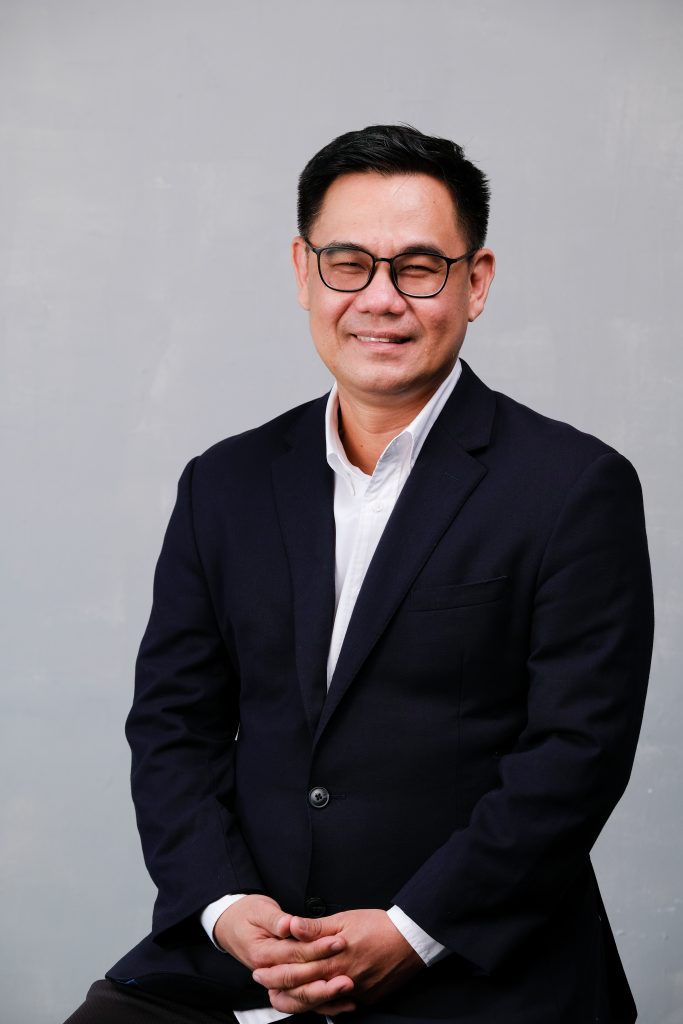
Shermon Cruz holds the UNESCO Chair on Anticipatory Governance and Regenerative Cities at Northwestern University, Laoag City, Philippines and Chief Futurist of the Center for Engaged Foresight.
Shermon Cruz
There is a moment I return to often in my memory where I stand at the edge of a river at dawn, and I feel that boundary between myself and the river dissolves. Then I sense, in silence, that the water flowing before me is memory, it is life itself. It is something far older and wiser than any human being ever could.
Is this a glimpse of a deeper truth? Is it the surface of a truth that I have spent years trying to make sense of? I tried to understand and articulate this through my studies and research into what I call The River of Dharma.
Rivers as the Backbone of Civilization
My inquiry begins with Prabhat Ranjan Sarkar, a spiritual guru and socio-linguistic philosopher whose life work continues to guide my own. I began to search and read more than a hundred of Sarkar’s stories, analyses and writings on rivers and civilizations. He posited that rivers are not merely hydrological features of the landscape. They are the very backbones of human civilization. Before wells, before roads, before the scaffolding of the modern state, rivers were where human beings first gathered, first exchanged, first formed the bonds of community and culture. Along their banks, languages were born. At their confluences, civilizations merged and blossomed into something greater than the sum of their parts.

Sarkar observed that each phase of a river parallels a stage of civilizational development: the hill stage, swift and original, giving rise to simple languages and early cultures; the plains stage, where streams converge, and dialects interweave; and the delta stage, expansive and complex, where the full richness of a civilization reaches its flowering. In this view, the river appears to be the author of human history.
What strikes me most deeply in his writing is the recognition that rivers carry within them something Sarkar called dharma — the intrinsic sustaining essence of life and the cosmos. For Sarkar, a river flowing to the sea is not simply obeying the laws of physics. It is an enactment of a moral and spiritual journey, from origin to union, from the individual stream to the vast ocean of consciousness. And thus to live near a river, to depend on it, to revere it, is to participate in that dharmic journey.
What We Have Lost — and What We Are Doing to Ourselves
Yet look at what we have made of our rivers. Across the world — and painfully close to home, as I see in the Pasig River here in the Philippines — rivers have been reduced to open drains, to industrial corridors, to contested real estate along their banks. We have treated them as objects to be engineered and owned, rather than as living relationships to be tended.
In my research, I call this dominant paradigm the Masters of the Universe — a worldview in which humans stand above nature, controlling and extracting rather than listening and reciprocating. Under this paradigm, rivers are severed not only from their ecological function but from their cultural and spiritual role. The communities that once gathered along their banks drew meaning from their floods and seasons and sang songs in their honor. These communities’ succeeding generation, unfortunately, are fragmented, their stories suppressed, their indigenous place names erased and replaced by the language of colonial rule and corporate development.
Sarkar understood this deeply. He lamented that the decline of rivers often paralleled the decline of civilizations. Marked not only by ecological degradation but by cultural amnesia, a forgetting of who we are and where we come from. For Sarkar, when we pollute a river, we not only harm an ecosystem. We sever ourselves from our own memory. I feel this deeply as a Filipino living in Metro Manila, where the Pasig River and the surrounding landscapes hold centuries of stories that colonialism and industrialisation have tried their hardest to erase.
Neohumanism and the River as Sacred Being
It is here that Neohumanism offers us something transformative and necessary. Sarkar’s Neohumanist philosophy extends our circle of love and ethical responsibility beyond the human family to encompass all living beings — plants, animals, rivers, and the Earth itself. It calls us to recognize the intrinsic value of every expression of life, not merely its utility to us.
When I look at a river through Neohumanist eyes, I do not see a resource. I see a sacred being. I see a teacher of interdependence, a mirror of the soul’s journey from ego to expansion, from the self to the cosmos. The river asks us: Can you move as I move — with patience, with persistence, shaping the landscape not through force but through faithful flow?
This is not a metaphor alone. In Aotearoa New Zealand, the Whanganui Māori have long declared: “I am the river, the river is me.” The Whanganui River was granted legal personhood. Recognized as a living entity with rights, powers, and protections equivalent to a human being after more than a hundred years of struggle. This is Neohumanism made law. It is what becomes possible when a society genuinely shifts its consciousness from domination to relationship to kinship. I hold this example close as I imagine what is possible for the rivers of the Philippines, and for rivers everywhere.
The River of Dharma: A Vision for Our Cities
The transformed future I envision in my research, I call The River of Dharma. In this world, rivers are restored as the pulsating core of urban life. Cities are reimagined not as landscapes that contain rivers but as riverscapes — their rhythms, their architecture, their governance all aligned with the flow of water. Seasonal floods are no longer disasters to be suppressed but cycles to be honored, ecological milestones celebrated as civic achievements.
Governance in the dharmic city is participatory and polycentric. Basin councils bring together elders, community leaders, women’s cooperatives, scientists, artists, spiritual practitioners, and local communities as co-stewards of the river. Their authority comes not from power over territory but from their embodiment of a shared ethic: that the river is a living commons, and its health is inseparable from our own.
Economies are regenerative rather than extractive. Prosperity flows like the river itself. Not pooling in one place but moving, sustaining livelihoods and ecosystems alike. And at the heart of it all is a spiritual recognition: that to care for the river is to care for ourselves, for our ancestors, for the generations who will come after us. PROUT’s principle of decentralized, cooperative stewardship becomes not an abstraction but a daily practice lived along the riverbank.
The River Speaks — Are We Listening?
Perhaps the most challenging question I sit with is this: What if we stopped treating rivers as objects of study and began engaging them as subjects in dialogue? What does the river communicate through its floods and its silences, its biodiversity and its degradation? What does the Pasig River say to Manila, if we choose to listen?
Sarkar believed that rivers are sentient manifestations of living energy. They are not mute. They carry within them the accumulated memory of civilizations, the ecological intelligence of millennia, and the spiritual current of dharma itself. In my own contemplative practice, I have come to feel this as truth — not as belief, but as direct experience.
I return, again and again, to that image of the dawn river. The dissolution of boundaries, the sense of participating in something vast and purposeful. That feeling, I now understand, is not escapism. It is recognition. It is listening. It is the self remembering its kinship with all of life.
The river does not flow through the city. The city lives within the river. And when we remember this — truly remember it, in our governance, our economies, and our daily spiritual practice — we will have taken the first step toward civilizational renewal.
The River of Dharma is not waiting to be built. It is waiting to be remembered.
Future and Foresight
Studying river-city interactions has revealed shifting assumptions about how we approach the future. I have explored three distinct paradigms of future and foresight: conquest, reverence, and reconciliation.
Rivers are not simply sites of ecological concern, urban transformation and governance. They also reveal how we relate to time, ancestral memory, power, and life itself.
Rivers are not infrastructure. They are civilizational agents. Sarkar saw rivers as the bedrock of civilization — shaping language at every bend, forging culture at every confluence, carrying spiritual meaning in every current. Every civilization begins and ends with water.
Yet we live under what I call the “Masters of the Universe” scenario — rivers dammed, polluted, commodified, severed from the communities that once thrived alongside them. This isn’t just an environmental crisis. It’s an ontological one.
The River of Dharma offers another path: cities as civilizational spaces sustained by rivers through harmony, not extraction. Polycentric governance. River equity. Regenerative economies. Cities designed as riverscapes.
Three insights I want to leave you with:
● Rivers carry ontologies. The way we see rivers — as resources, as kin, as sacred beings — shapes everything: our policies, our governance, our futures. The river futures we envision will flow along the currents of the ontologies we embody.
● Ontologies are not neutral. They are products of history, power, and consciousness. Some liberate rivers. Others subjugate them. As scholars and citizens, we must ask: which ontologies guide us toward dharma, and which lead us toward adharma?
● The river speaks — if we choose to listen. From the Whanganui Māori declaring “I am the river, the river is me” to emerging projects using AI and ecological wisdom to interpret rivers as communicative agents — a new epistemology is taking shape. One rooted in kinship, reciprocity, and care.
Rivers are not mute backdrops. They are sacred, alive, and worthy of our love, reverence, and stewardship.
Future studies are thus not only a method of anticipation but also a relational practice of listening, remembering, and learning from rivers how to cultivate a deeper relationship with the future.
This reflective piece is drawn from the author’s paper “The River of Dharma: Visions for Transforming River–City Futures,” published in the Journal of Futures Studies (2026).
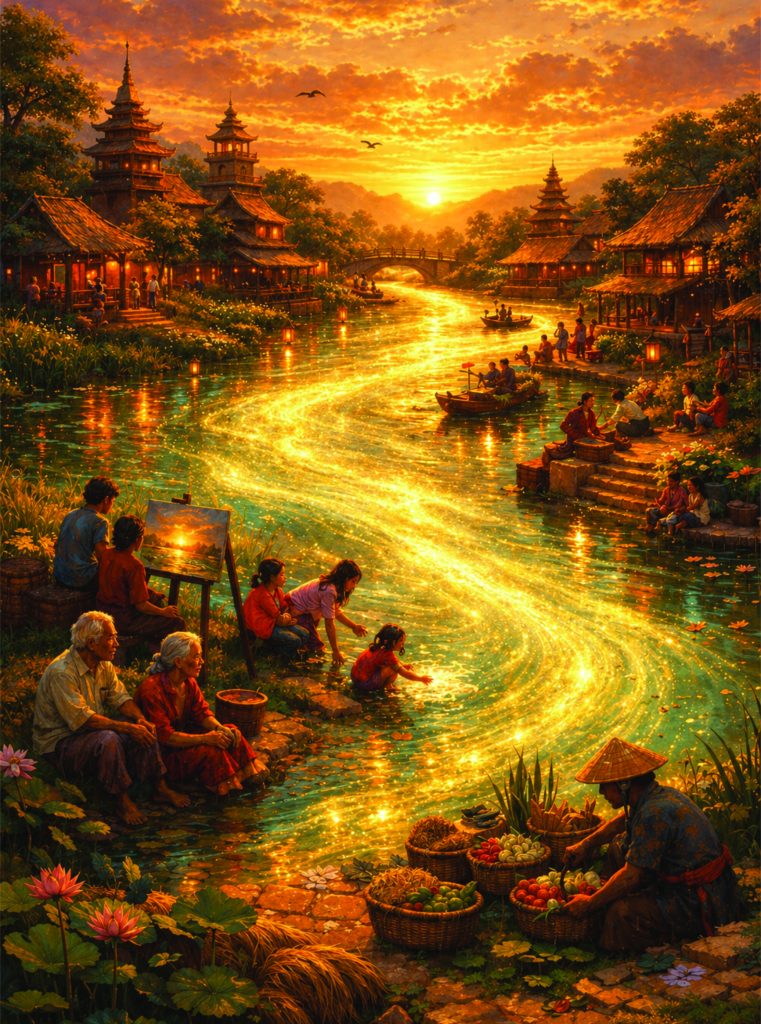
The image below depicts the river of dharma. A peaceful, life-giving river at sunset, surrounded by a thriving community. The river glows with golden light, suggesting renewal, abundance, and spiritual vitality. The river is no longer treated as a neglected space, but as a living entity and a shared sacred commons. Source: Image generated with the assistance of ChatGPT based on the author’s creative direction and concept.
Published in Neohumanist Review, 2/2026 • Issue 7, pp 24-27.